20.03.2022
Wolfgang Swietek
The association “Themar meets Europe” was awarded the Werner Sylten Prize for Christian-Jewish Dialogue by the Evangelical Church of Central Germany.
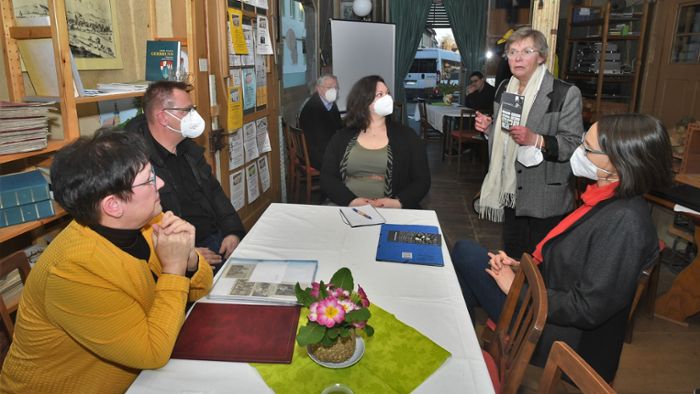
It was a small group that had gathered at Morgenroth’s house in Themar . There was a happy reason for the invitation: the association “Themar Meets Europe ” had been awarded the Werner Sylten Prize for Christian-Jewish Dialogue by the Evangelical Church of Central Germany (EKM). Church Councilor Charlotte Weber from the Regional Church Office in Erfurt was responsible for explaining the reasons for the selection and subsequently presenting the award. She, too, was impressed by what she saw and heard during the meeting.
There was an impressive film about how it all began in Themar . And, of course, there were stories from Sabine Müller, the chairwoman of the association, and from Barbara Morgenroth, who, with her exhibition “They were Themarers,” had once set the first sign of respect for a topic that was subsequently addressed by a specially founded association—and continues to be addressed.
“It all began in 2008 with the repair of the church tower of our St. Bartholomew’s Church,” recalls Sabine Müller. “The church tower knob was taken down, containing a box with contemporary witnesses from over 300 years of history. But not a single word was heard about the darkest chapter in German history, the repression against the Jews and their deportations. Barbara and Arnd Morgenroth had already spoken with older citizens, with contemporary witnesses, and had heard about the horrific events in Themar on the night of November 9, 1938 alone, and had received names of former Jewish families in Themar.” Barbara Morgenroth then compiled her exhibition “They were from Themar” from this information.
Around the same time, the Canadian historian Sharon Meen from the University of Vancouver received a box of letters in German from Manfred Rosengarten. At the age of 14, he and his family had to leave Themar. Until his death in California in 1987, he was unable to forget his hometown of Themar and therefore maintained an extensive correspondence with former schoolmates and playmates from Themar. After his father’s death, Manfred Rosengarten’s son received these letters and brought them to Sharon Meen for translation. Meen found them so impressive that she was eager to get to know Themar – and did so for the first time in 2008. Since then, she has visited the small town on the Werra River several times. This has led to a close friendship and close collaboration with the members of the “Themar meets Europe ” association, with new chapters being written year after year.
One of these is the laying of stumbling stones to provide a visible symbol of remembrance for the Jewish citizens who once lived here. There are now 66 such stones, placed at fifteen locations throughout the town. The association itself financed the first stone, and many more were subsequently donated by private individuals, school classes, or other associations. What made this laying of the stones so special was that relatives or descendants of these Jewish citizens were always present, often traveling from great distances. And on these occasions, they sometimes learned things about their own ancestors that they themselves hadn’t known, things that had only been rediscovered through the research of Sharon Meen and the members of the Themar association.
Pure emotion was unavoidable at almost all of these events. “I wouldn’t want to miss any of these unforgettable gatherings,” admits Sabine Müller. “With our 66 stones, our former Jewish fellow citizens are not forgotten. Because a person is only forgotten when their name is forgotten. But they are also a reminder that something like this must never happen again.”
Charlotte Weber was deeply impressed by all of this. Of course, she knew why she should present the Werner Sylten Prize to the “Themar Meets Europe” association, as the jury had thoroughly examined which of the applicants were eligible for such an award . Nevertheless, she was once again captivated by the conversations and stories in this small group at Morgenroth’s house.
Wound of Christianity
“The EKM promotes Christian-Jewish dialogue. It recalls the church ‘s complicity in the exclusion and destruction of Jewish life, advocates for reconciliation with the Jewish people, and opposes all forms of anti-Semitism and anti-Judaism.” This is stated in the constitution of the Evangelical Church in Central Germany. To fulfill this mandate, the EKM has established an Advisory Council for Christian-Jewish Dialogue, which networks and promotes the EKM’s various activities in this field.
“By promoting Christian-Jewish dialogue, we want to do our part to heal a wound that runs through the history of Christianity,” says Charlotte Weber. “A lack of understanding that Christianity’s demarcation from the Jews led to a deliberate lack of understanding, the more Christianity allied itself with secular powers.” What particularly impressed Church Councilor Charlotte Weber here in Themar, however, was: “You are giving back a face and a story to the people who lived here, who were expelled and murdered. In doing so, you cannot ignore the guilt of individual people from Themar. Things are being brought to light that others would rather remain silent about.” He continued: “I find it significant that you are doing this as the association ‘Themar meets Europe’. As the association that represents Themar’s face to the world. One impulse with such external representation can always be to draw a veil over what was not good in your own history. You have chosen the other path. You have come to terms with your history and can now approach others uprightly and honestly and look them in the eye. Not just the people in your twin towns.”
In closing, the laudatory speaker said: “The desire to call injustice by its name, to contribute to reconciliation, and to facilitate encounters unite us. We are pleased that very diverse people are working together here on this issue. And thus contributing to confronting anti-Semitism and misanthropy in the future.” One lesson remains from all this: We cannot hold today’s generation responsible for what their fathers and grandfathers did. But we can demand that they confront this terrible time.