(formerly Kurfürstenstraße)
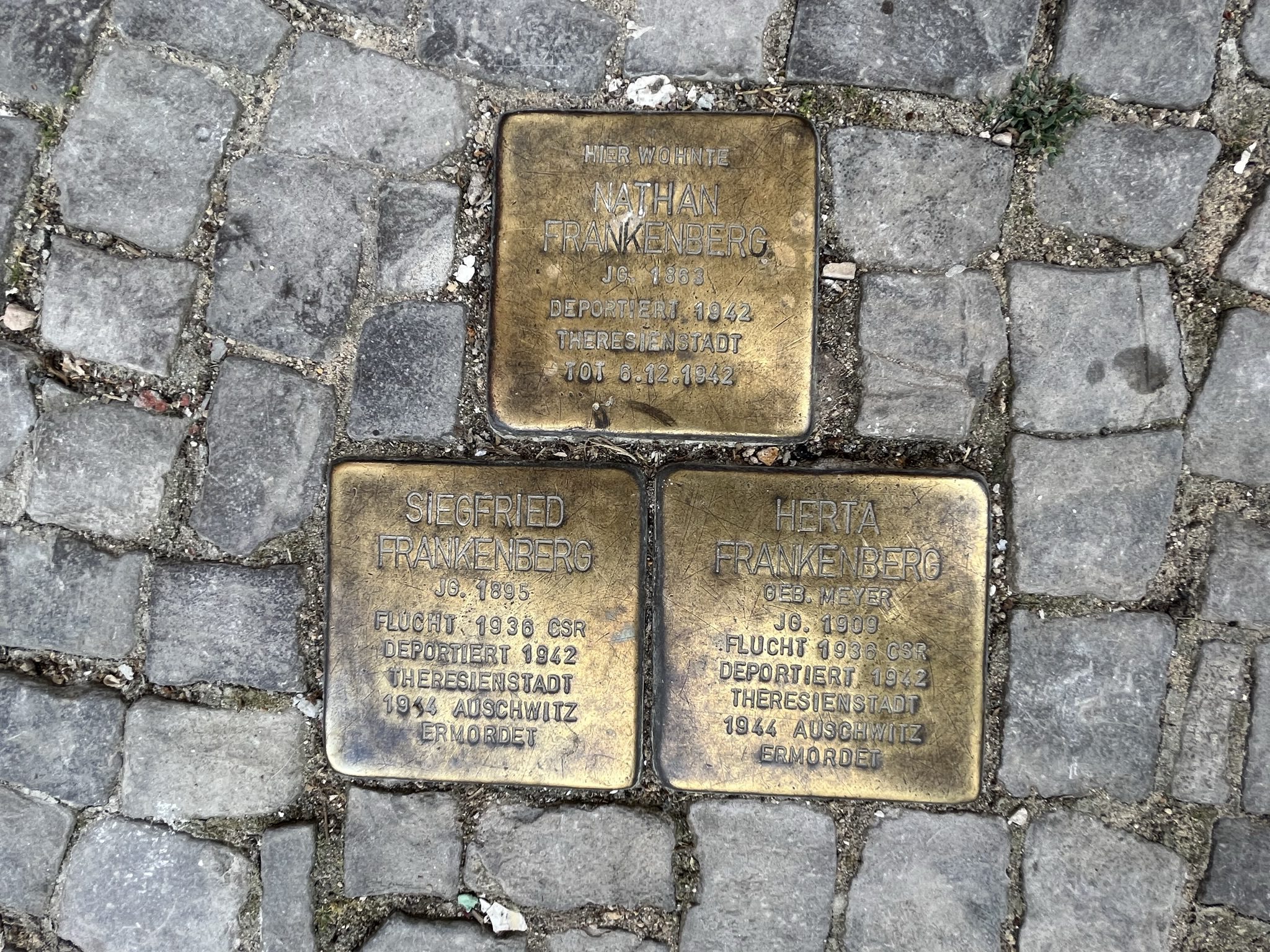
Nathan Frankenberg and Minna Frankenberg, née Gassenheimer, lived here.
IN MEMORIAM Siegfried Frankenberg and Dr. Herta Juliane Frankenberg, née Meyer
Nathan Frankenberg was born on September 5, 1863, in Marisfeld/Hildburghausen. Together with his brother Max and their father Jacob, he ran the company “Gebrüder Frankenberg” (Frankenberg Brothers) from 1879 onward, trading in cattle and horses in Themar and Coburg.
In November 1894, he married Minna Gassenheimer (born December 1, 1872, in Themar). Her family operated a large, diversified company, “Joseph Gassenheimer & Söhne” (Joseph Gassenheimer & Sons), which manufactured agricultural machinery.
Minna and Nathan Frankenberg lived in Coburg, where their two sons, Siegfried (born November 4, 1895) and Walter (born October 20, 1897), were also born. They were an outwardly mismatched couple; Minna was about a head taller than Nathan, yet they loved each other very much.
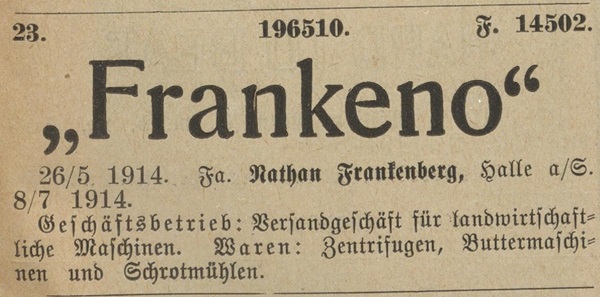
In 1903, the family moved to Halle, where Nathan Frankenberg registered a business. He, like several men who had married into the Gassenheimer family, was by then involved in the distribution of agricultural equipment. In 1914, he attempted to establish his own mail-order business under the brand name “Frankeno.”
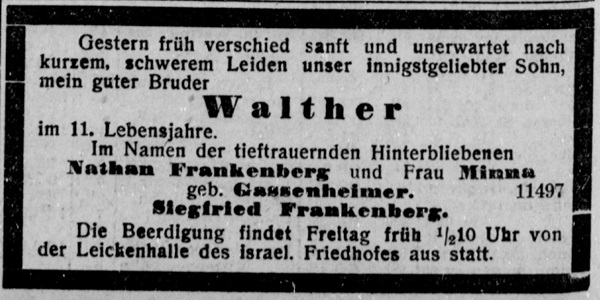
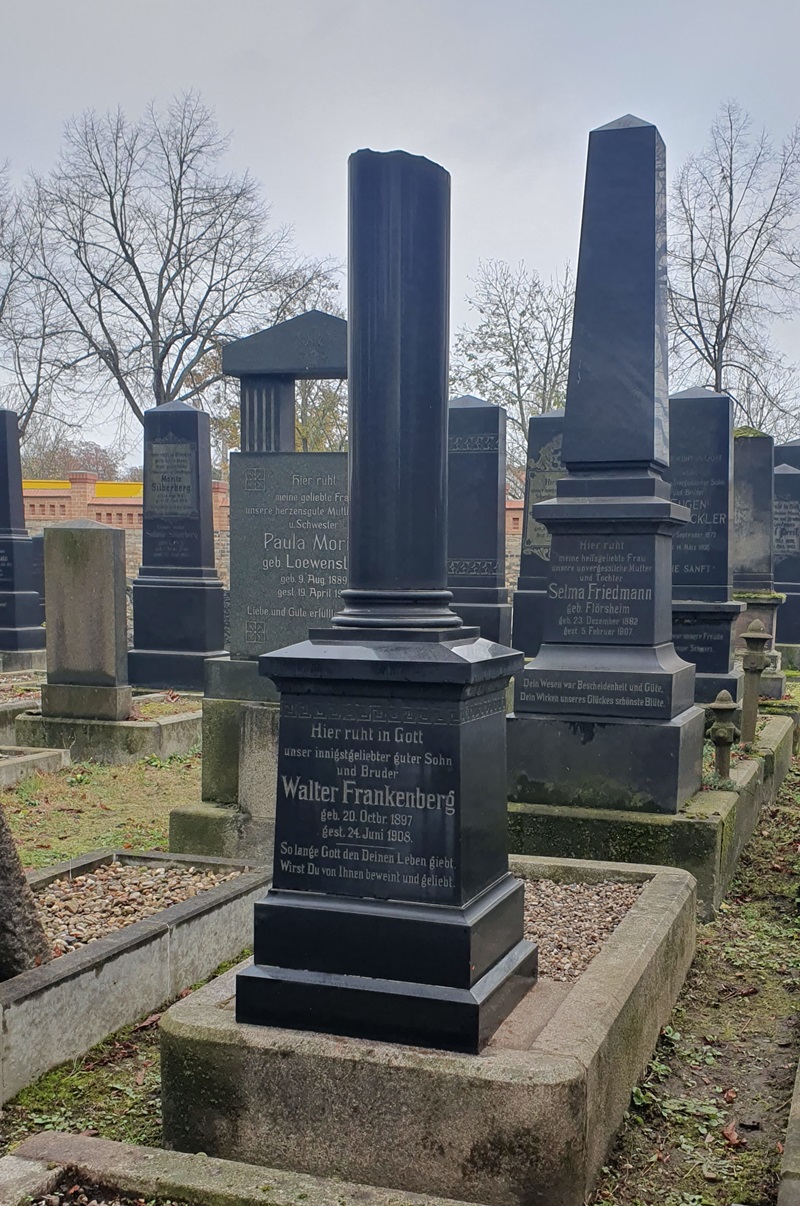
In June 1908, the family suffered a tragic event. Their son Walter died of appendicitis at the age of ten. According to his death certificate, he did not die at home, but at Grünstraße 7/8, where the private clinic of Dr. Kneise, a specialist in obstetrics and gynecology, was located at that time.
Other relatives of Minna had also moved to Halle, including her brother Georg Gassenheimer and his wife in 1903, her sister Emma Marcus with her husband and three sons around 1912 (->Stolpersteine Kirchnerstraße 17), and her sister Elise Ney with her son, who also lived with the Frankenbergs for a time (->Stolpersteine Maybachstraße 2).
Minna Frankenberg was active in the Israelite Women’s Association of the Jewish community. Nathan Frankenberg was a member of the Brothers of Mercy, the Central Association of German Citizens of Jewish Faith, and was involved with the Bikur Cholim Association, a visiting service for elderly and sick members of the community.
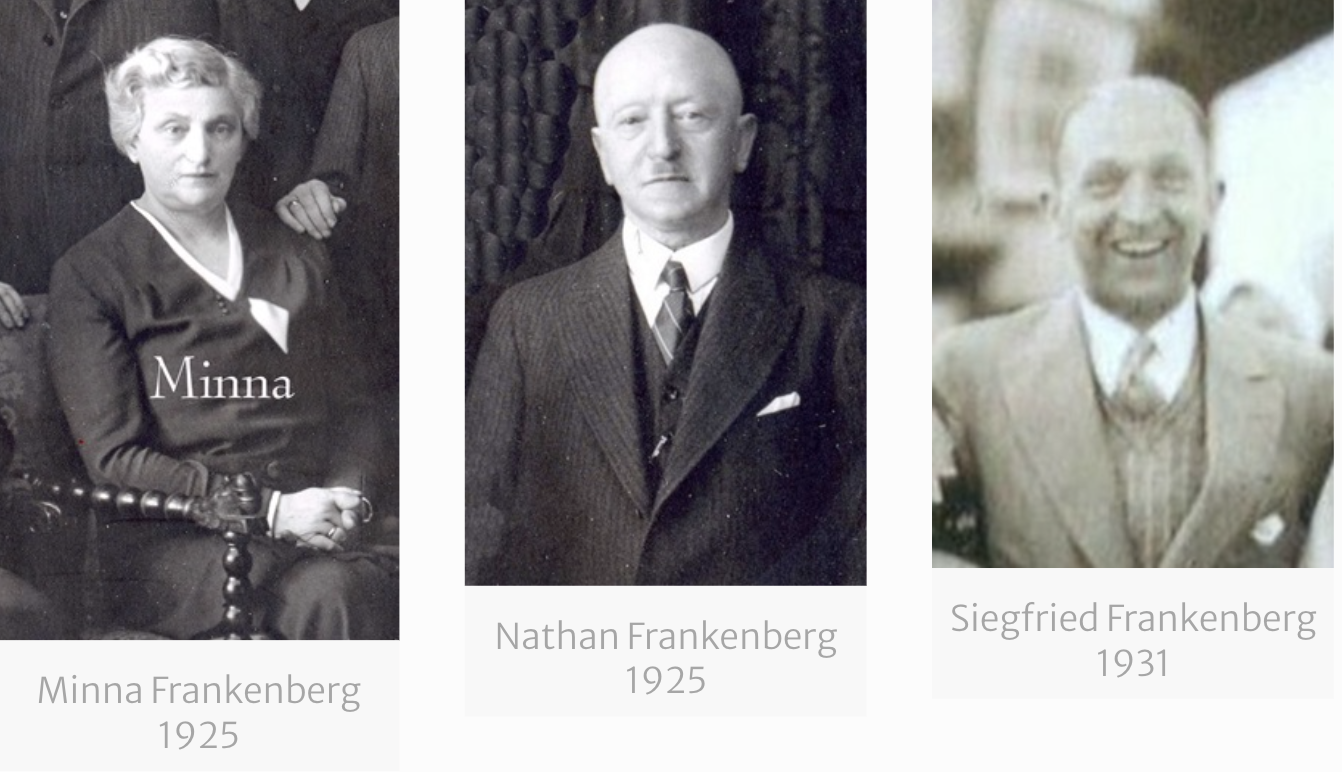
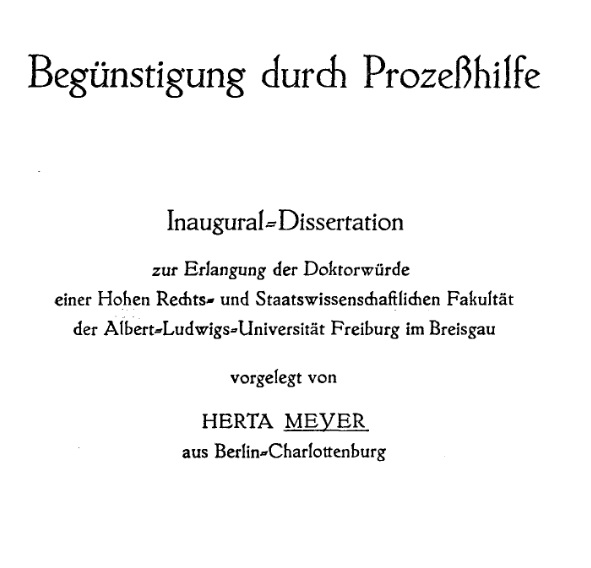
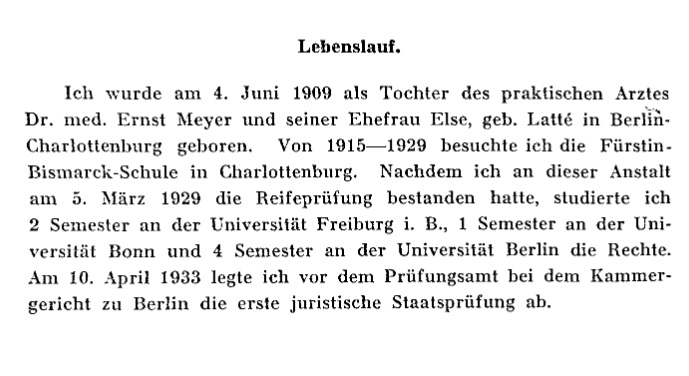
Minna and Nathan Frankenberg lived in Halle with their son Siegfried at Prinzenstraße 12 (now Friedrich-List-Straße). In July 1936, Siegfried Frankenberg married Herta Meyer (born June 4, 1909, in Berlin). She had studied law in Freiburg, Bonn, and Berlin, received her doctorate in 1933 with a dissertation on “Favoring Proceedings through Legal Aid,” and before the wedding lived with her parents, Else and Dr. Ernst Meyer, at Savignyplatz 11 in Berlin.
After their marriage, the young couple left Germany from Halle and settled in Poděbrady, in what was then the independent Czechoslovak Republic.
In 1938, the German Reich revoked their citizenship, and the University of Freiburg subsequently revoked Herta Frankenberg’s doctoral degree.
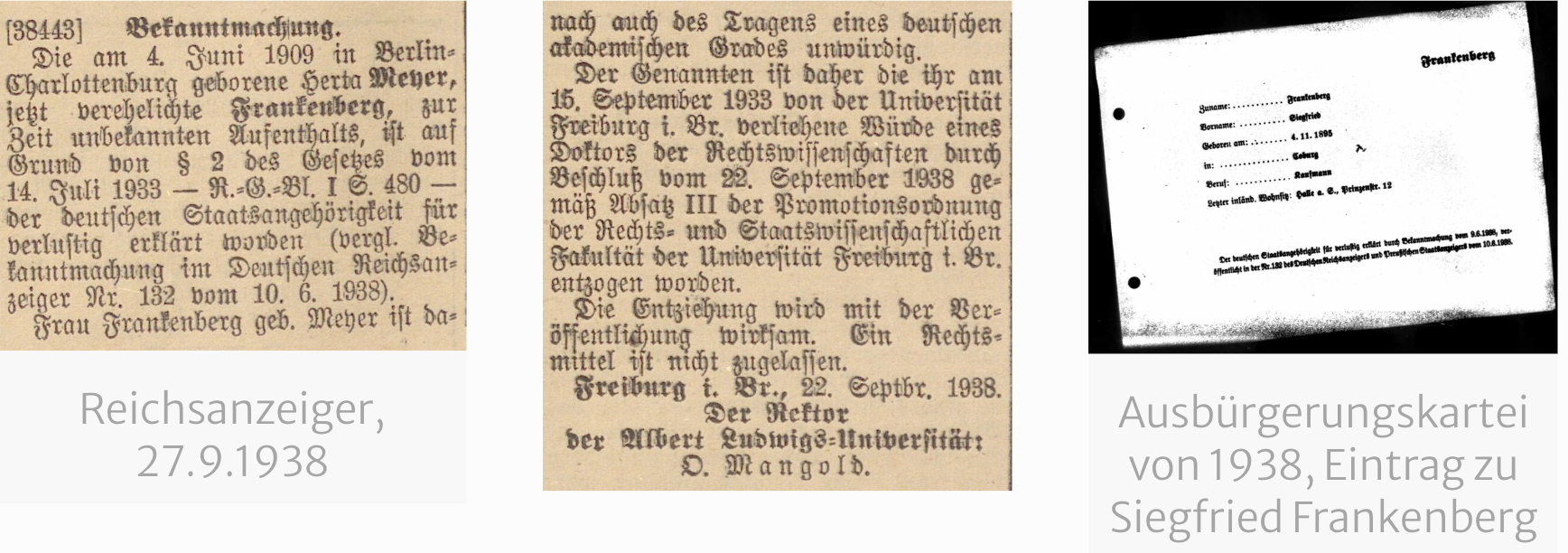
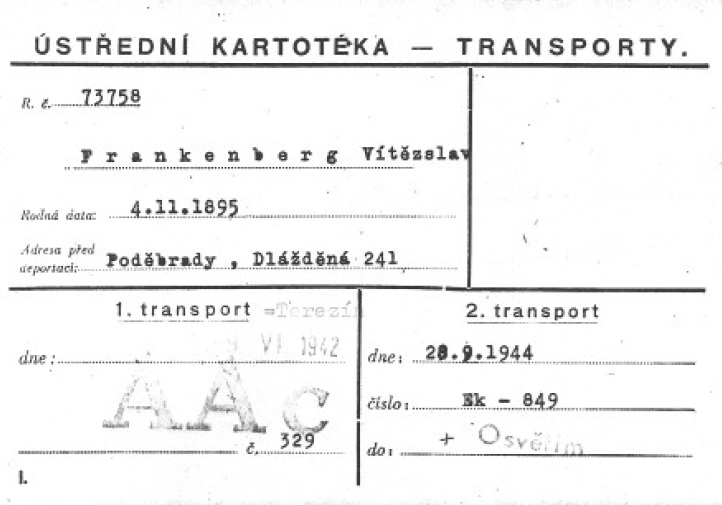
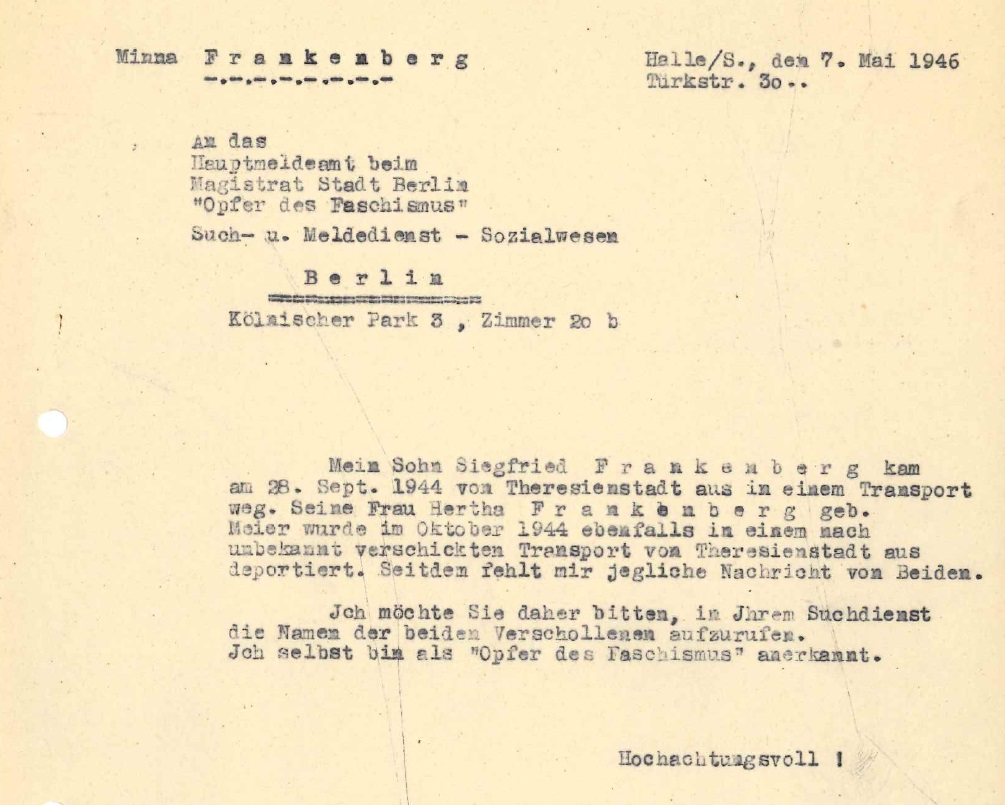
After the German occupation of Czechoslovakia, Siegfried Frankenberg was deported from Kolín to Theresienstadt on June 9, 1942, and then to Auschwitz on September 28, 1944. Herta Frankenberg was deported from Prague to Theresienstadt on December 22, 1942, and then on to Auschwitz on October 19, 1944. The 38-year-old and her 48-year-old husband were gassed upon arrival in Auschwitz.
After their son and daughter-in-law emigrated in 1936, Nathan and Minna Frankenberg had moved to Kurfürstenstraße 74, now Feuerbachstraße.
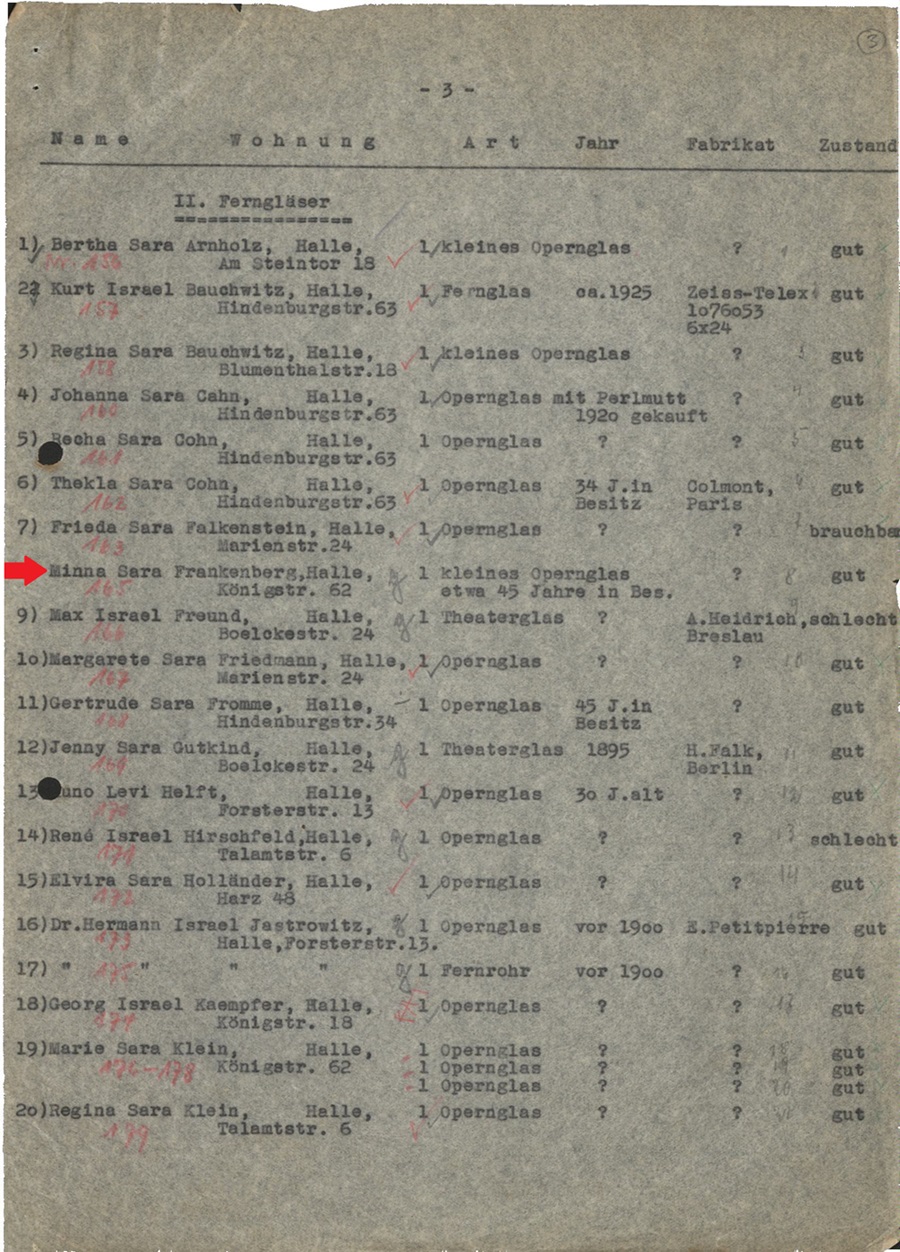
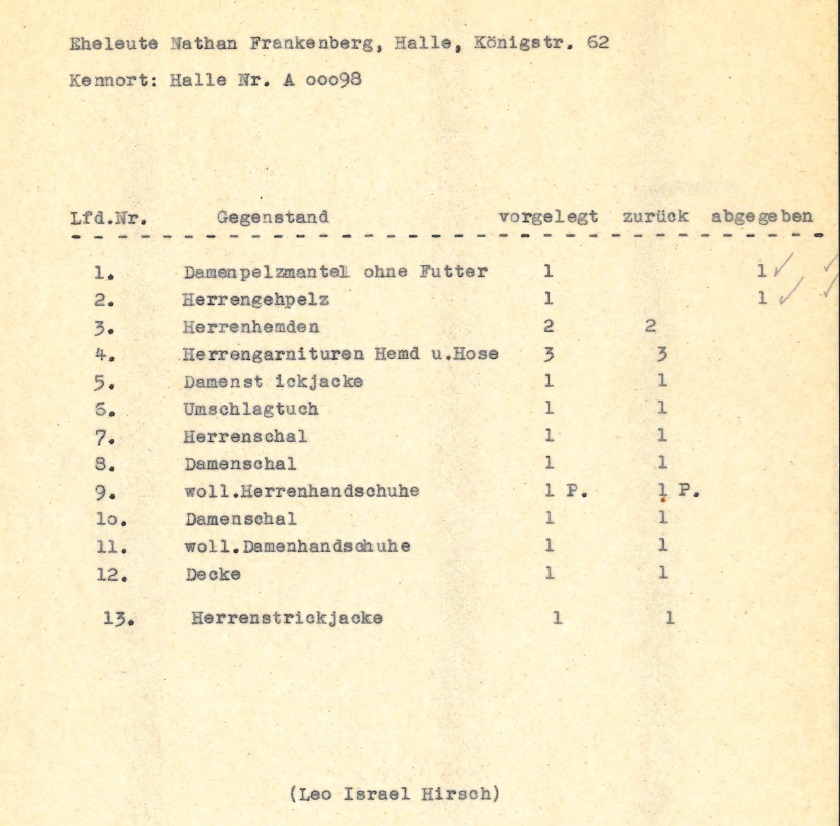
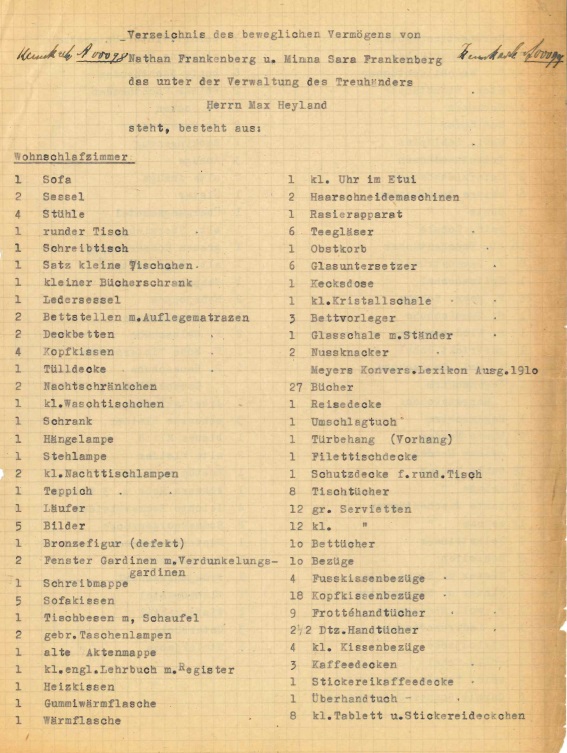
However, when the Nazi racial laws prohibited Jews and “Aryans” from living under the same roof, they were forced to leave their apartment in 1939 and initially moved to the building at Magdeburger Straße 28, designated as a “Jewish house” (->Stolpersteine Magdeburger Straße). Here, in March 1939, the Frankenbergs also received a demand from the tax office to pay the “Jewish property levy,” according to which German Jews had to pay a total of one billion Reichsmarks as a special tax. Anyone with assets exceeding 5,000 Reichsmarks had to surrender 20% of their wealth; in the Frankenbergs’ case, this amounted to 5,650 Reichsmarks. The calculation was simple for the authorities, since all Jewish citizens had already been forced in the spring of 1938 to disclose their assets and, from the autumn of 1938 onward, to have them held in trust.
Towards the end of 1940, the Frankenbergs moved again, this time to the house of the Schloß family (->Stolpersteine Rudolf-Ernst-Weise-Str. 20), where several other Jewish families had already found refuge.
During this time, Nathan and Minna Frankenberg registered with the emigration office and indicated the USA as their desired destination. To prepare, the already elderly couple took an English course at the Jewish community center. However, their chances of obtaining a visa were slim.
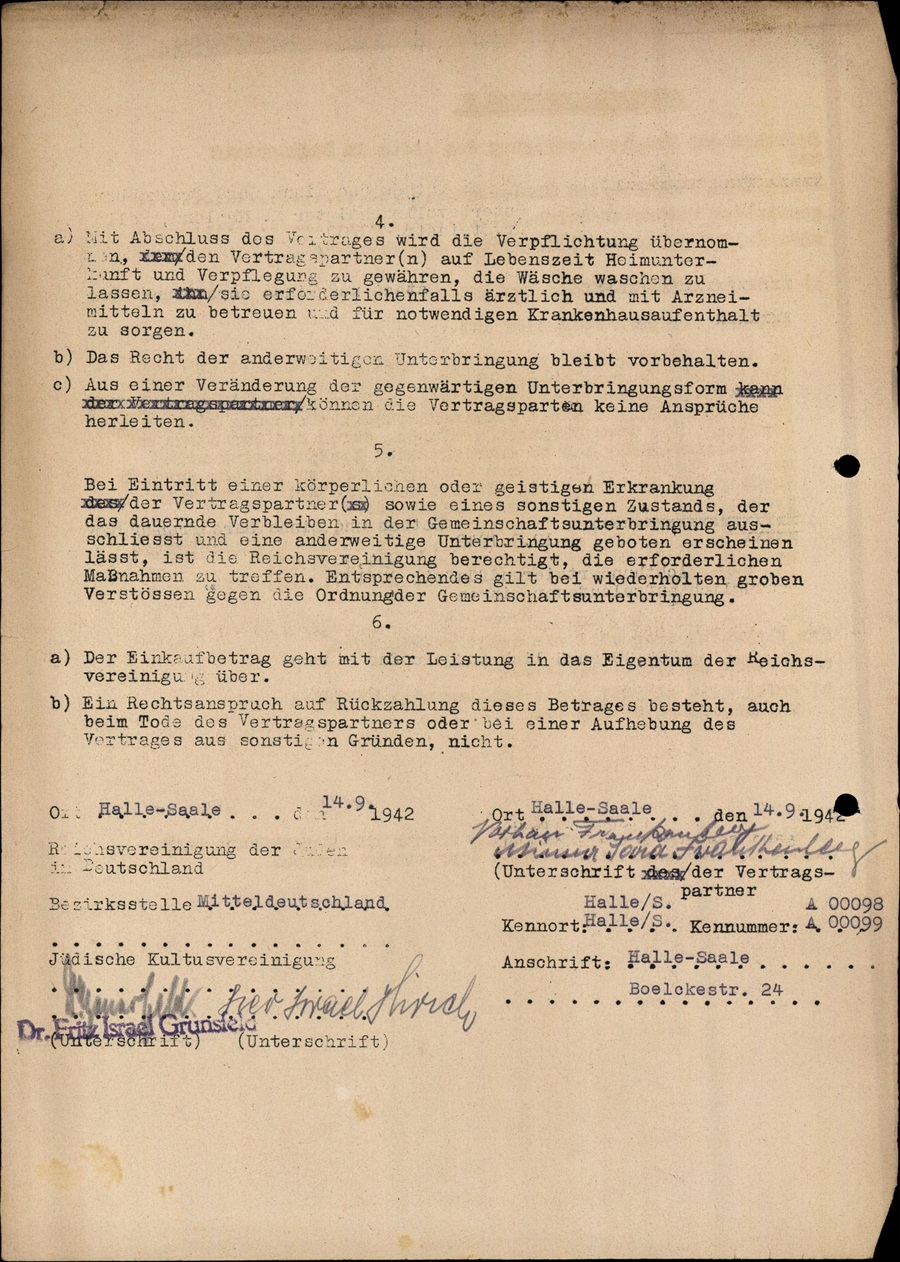
On June 30, 1942, Minna and Nathan Frankenberg were forced to leave this apartment as well and move into the so-called “old people’s home” on the grounds of the Jewish cemetery at Boelckestraße 24 (today Dessauer Straße). In reality, Jews were crammed together here in extremely confined spaces before their planned deportation. A monthly care allowance of 150 Reichsmarks was set for each spouse. The chairman of the Halle administrative office of the Reich Association of Jews (formerly the Jewish Community), which was entirely under Gestapo control, concluded an additional “home purchase contract” with Frankenberg and other residents, essentially as an “entrance fee” to the retirement home. For this, Frankenberg was to pay 4,000 Reichsmarks into the retirement home’s “residents’ special account.”
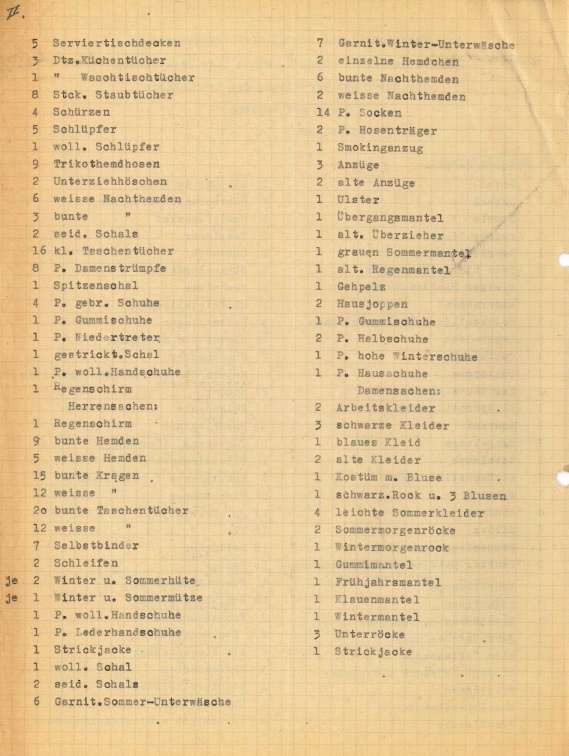
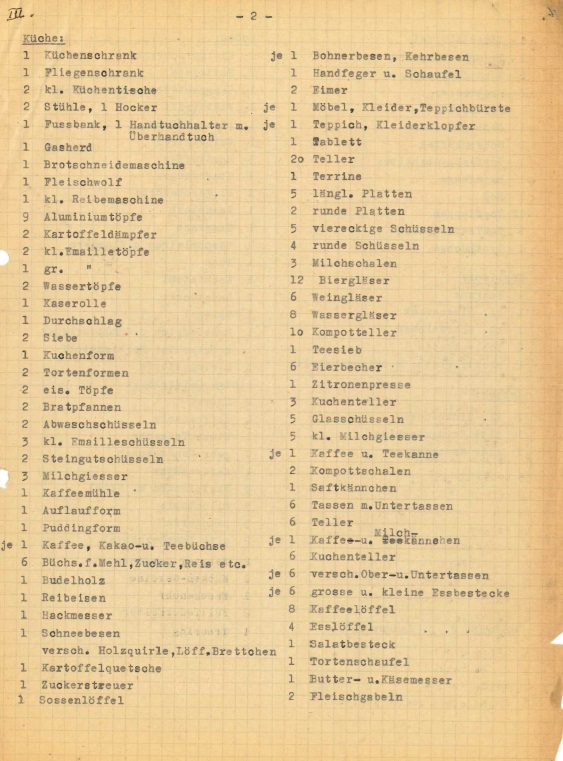
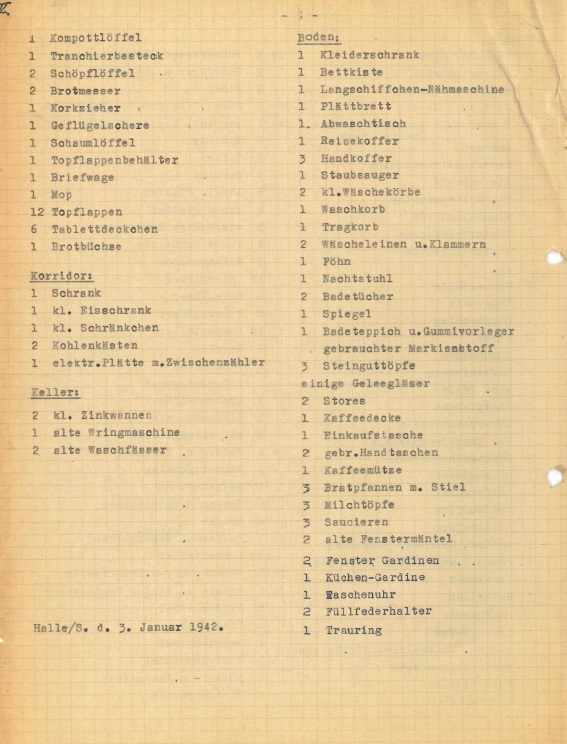
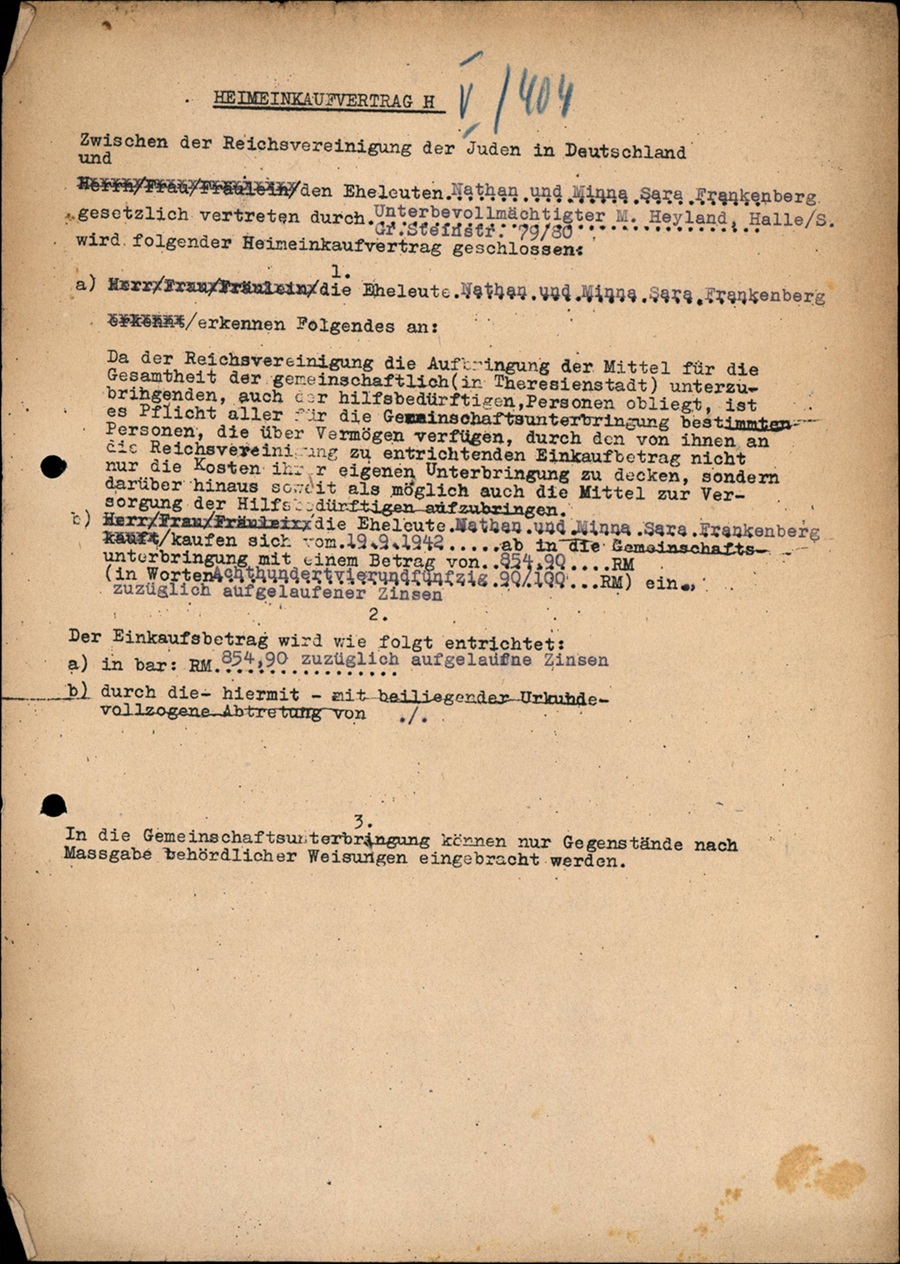
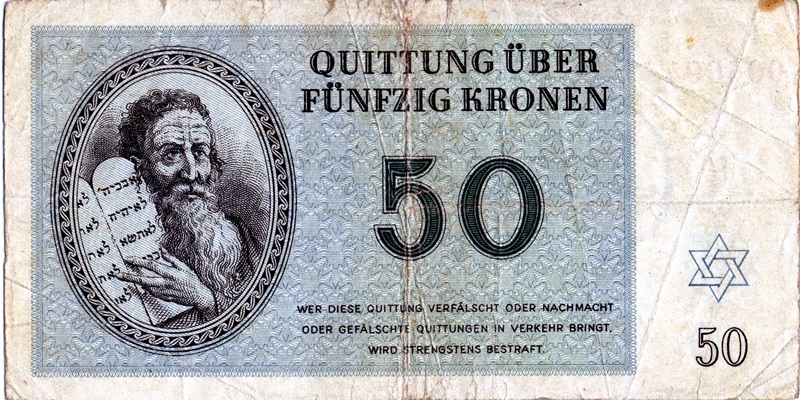
Just a few weeks later, the couple learned that they were slated for deportation to Theresienstadt. Here, too, they were required to sign a “home purchase contract,” which in reality served to legally rob deportees of their assets. By signing the contract on September 11, 1942, the Frankenbergs stipulated that their remaining assets of 854.90 Reichsmarks be transferred to Special Account H of the Reich Association of Jews. All assets deposited there by deportees to Theresienstadt were transferred to the Reich Security Main Office in 1943.
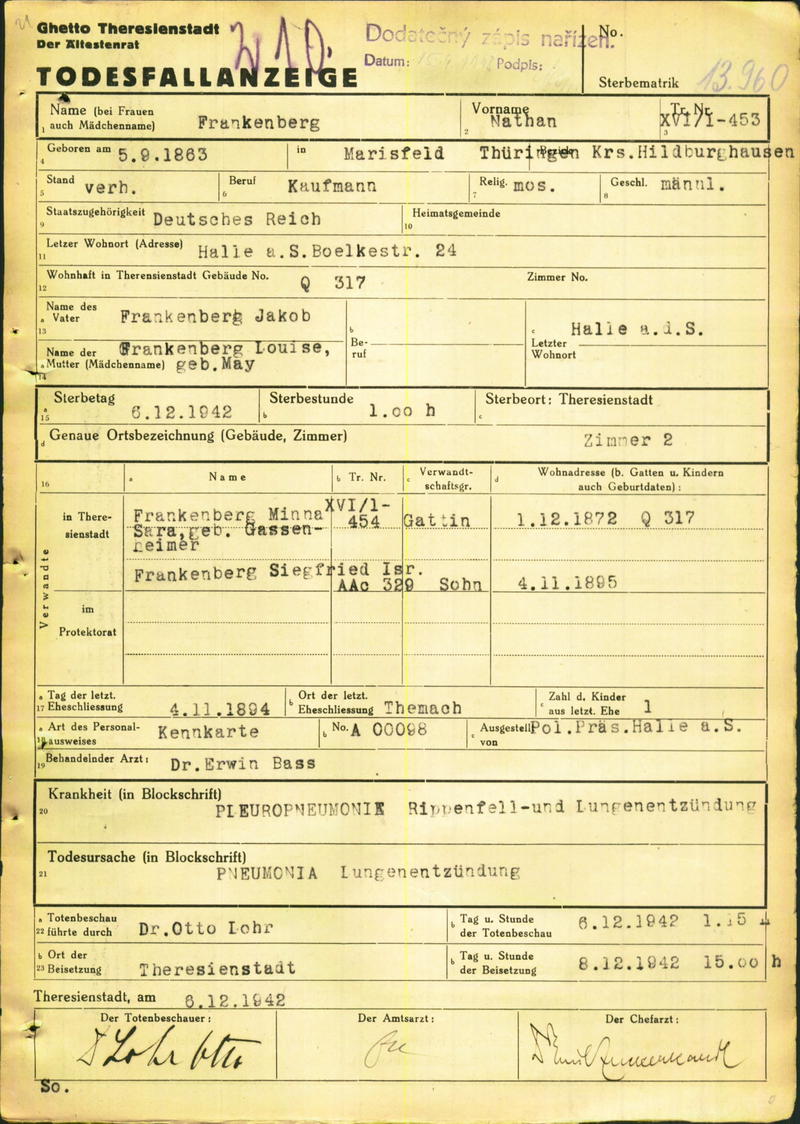
On September 19, 1942, Minna and Nathan Frankenberg were deported to Theresienstadt. There, 79-year-old Nathan Frankenberg died on December 6, 1942, presumably from pneumonia.
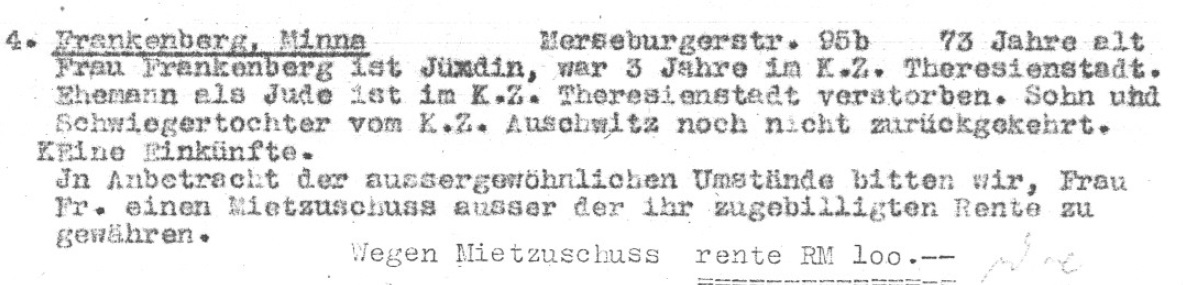
Minna Frankenberg was the sole survivor of her family and returned to Halle in July 1945.
The 73-year-old was initially assigned accommodation at Merseburger Straße 95b.
Having lost everything and having no means of earning a living, she lived on the meager subsidies from the Jewish community, which had been re-established after the war. Only later did she receive a widow’s pension.
In 1947, Minna Frankenberg again attempted, unsuccessfully, to emigrate to the USA.
From at least 1950 onward, she lived at Türkstraße 30. Her will, written in 1960, suggests that she was no longer experiencing any existential financial worries. She left her estate to neighbors, friends, and the Association of Jewish Communities in the GDR, stipulating that it be used to improve the living conditions of needy and elderly members of the community.
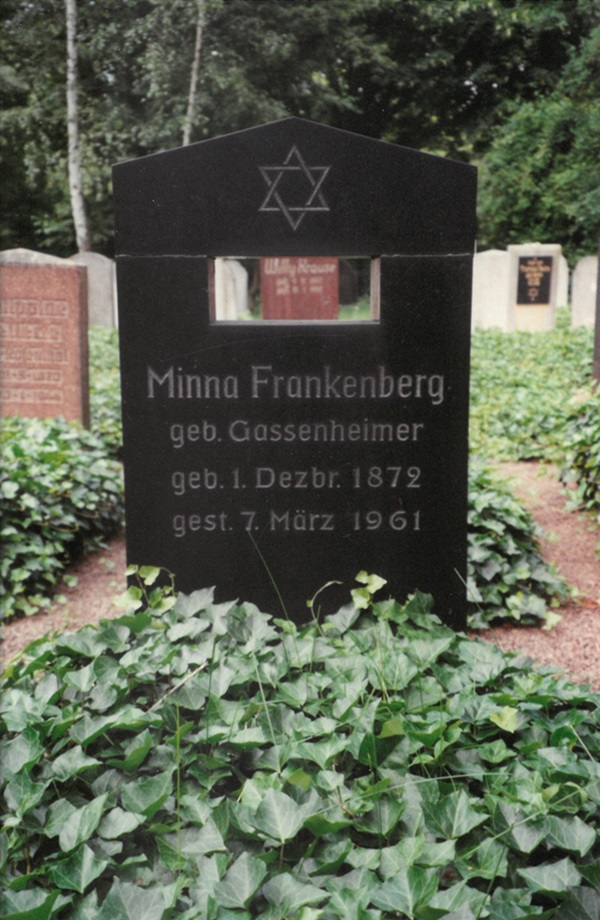
She died on March 7, 1961.
—
During the bombing of Halle in the final months of the war, Prinzenstraße, near Riebeckplatz, the last residence of Herta and Siegfried Frankenberg in Halle, was destroyed and later built over. As a memorial, Stolpersteine (stumbling stones) were placed in front of their parents’ last home.
Minna Frankenberg’s brother, Georg Gassenheimer, and his wife, Selma, were murdered in Auschwitz. Her sister, Elise Ney, was deported with her to Theresienstadt but died there just two weeks after arrival.
After the war, Minna maintained contact with her young great-nephews Erich, Dieter, and Peter Marcus in Halle until they emigrated to the USA in 1948.
Herta Frankenberg’s parents, Dr. Ernst Meyer and Else Meyer, left Berlin on September 26, 1942, with a transport of over 1,000 other people bound for Raasiku/Jägala concentration camp/Estonia. They never returned. Her brother Alfred Meyer was able to emigrate to England in time.

Sources and further information
Halle (Saale) City Archives, in particular the Gudrun Goeseke Papers
Centrum Judaicum Berlin
Volkhard Winkelmann and the former student project “Jews in Halle” of the Südstadt-Gymnasium Halle (eds.): Our Memorial Book for the Victims of the Holocaust in Halle. 3rd edition (2008)
Entry on Nathan Frankenberg
Entry on Hertha Frankenberg
Entry on Siegfried Frankenberg
Descendants of the Gassenheimer family, in particular Dieter Marcus
Sharon Meen and her project “Jews in Themar” (https://judeninthemar.org/de)
Martin Schumacher: Expatriated under the Swastika. Racially and politically persecuted lawyers. Biographical documentation of a search for traces of German emigration after 1933. Münster 2021.
German Newspaper Portal
Arolsen Archives
National Archives Prague
Life at Boelckestraße 24 – In the Footsteps of Isidor and Frieda Hirsch
A film by Inga Dauter, Doreen Hoyer, and Elisabeth Schinner (2014, 13 min)
Produced as part of the project “Stolpersteine – Films Against Forgetting” of the Master’s program in Multimedia & Authorship at Martin Luther University Halle-Wittenberg, 2014