On Wednesday evening, Stolperstein creator Gunter Demnig will give a lecture about the path he took as an artist to arrive at the Stolpersteine.
By Cornell Hoppe, insuedthueringen.de
March 6, 2026
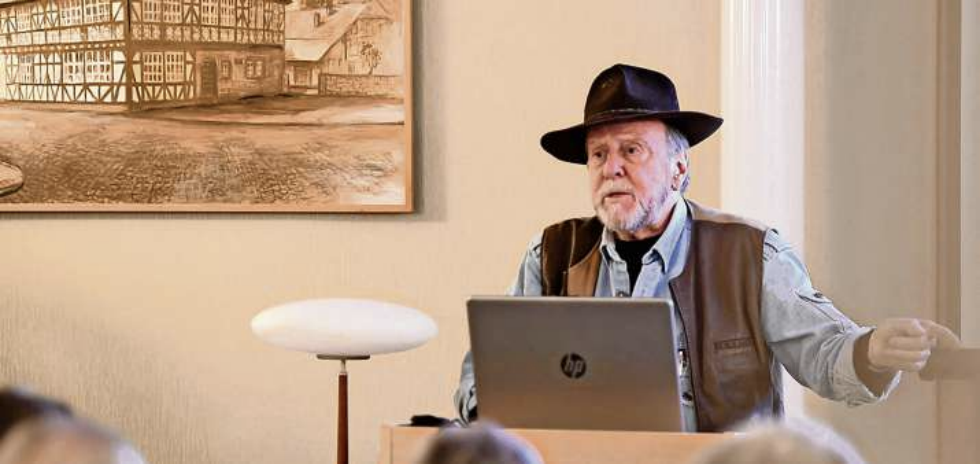
Themar. On the eve of the Stolperstein (stumbling stone) laying ceremony, numerous guests gathered at the Themar town hall. Residents of Themar, descendants of the Jewish families from Themar, and also a number of interested parties who would like to have Stolpersteine laid in their own hometowns in the future, wanted to hear Gunter Demnig’s presentation. After many years, Gunter Demnig was once again a guest in Themar. Demnig is the “creator” of the Stolpersteine; he calls them his life’s work. On Wednesday evening, he gave a lecture from which the audience could learn a little more about Gunter Demnig the man and the artist, and how his path—one might say purposeful—led him to his Stolpersteine.
Gunter Demnig almost became a Lufthansa pilot, he recounts. After graduating with excellent grades in his Abitur (university entrance exam), he obtained his pilot’s license. Shortly before the exam, he announced to his family that he would rather study art than be a better bus driver. West Berlin, Kassel, and Cologne became his starting points. “Traces” became one of his lifelong artistic themes. Using chalk paint or blood and self-built machines, he printed on streets, connecting places. As an art project, he linked the two locations with the most important exhibitions of modern art—Documenta in Kassel and the Venice Biennale—with a common thread. Literally. 1,000 kilometers on foot, with a spool of paper strapped to his back.
He worked with writing and etched the Universal Declaration of Human Rights into clay tablets in 120 languages. And finally, in Cologne in 1990, he commemorated the deportation of Sinti and Roma by printing the words “May 1940 – 1,000 Sinti and Roma” hundreds of times on the streets of Cologne using facade paint—from the people’s last known residences to the Deutz trade fair grounds, from where they were deported to labour camps in the East.
From 1992 onwards, the Stolpersteine (stumbling stones) followed a similar motif. Each block, with a brass plate, measures 9.6 x 9.6 x 10 centimeters. Engraved on it are the details of the people who were persecuted, expelled, and murdered by the Nazi regime. One stone for each person – individual and handcrafted. All inscriptions are hammered into the brass sheet by hand.
The stone is embedded in the pavement or asphalt in front of the last freely chosen residence of the person. “For me, it was initially more of a conceptual work,” says Demnig in Themar. Essentially an idea, a symbol. The Cologne pastor Kurt Pick, with whom he discussed it, agreed that it was a huge undertaking. But as with everything, one has to start somewhere. From that beginning, 124,000 stones have now been placed in 32 European countries. Just last year, Andorra, the small mountainous country between France and Spain, was added.
There are already 66 Stolpersteine (stumbling stones) in Themar. Four more were added on Thursday morning, and ten more are planned. For a town the size of Themar, that’s an enormous number.
The Spuren Foundation, which Gunter Demnig founded, now employs eight people full-time, and four or five volunteer on a case-by-case basis, the artist explains. Although he has been running the project for more than 30 years, he still gets excited about every new location, every new country, and every new stone that is added. Because one thing has never set in over all these years: routine. “After all, there are always new people, always new stories behind the names,” says Demnig.
Not everyone appreciates what Demnig does. He also addresses this in his presentation. 800 stones have been torn out. And he has received death threats. “In 30 years, three. You can live with that,” he says laconically.
Source: https://www.insuedthueringen.de/inhalt.stolpersteinverlegung-in-themar-gedenken-an-die-rosenbergs-und-gassenheimers.8124d149-0c71-48b9-9437-4f81b39725e8.html