The vote by the city council of a town close to Dresden to ban the laying of Stolpersteine has made headlines across Germany. (Below is the article that appeared in the TAGESSPIEGEL at 8pm this evening.) and elsewhere (see BBC article)
At issue is the role of the CDU (Christian Democratic Party) in the success. The CDU cooperated with the AFD (Alternative for Deutschland) in tabling the motion and seeing it through the vote of 13-6.
Gunter Demnig, the artist who initiated the Stolperstein project, said that given the recent electoral successes (in Saxony-Anhalt and Mecklenburg-Vorpommern of the AfD “it was certainly to be expected that something like this would happen”.
Demnig accused the center-right CDU (Christian Democratic Union) of abandoning Christian values. He said the party of Chancellor Friedrich Merz “should maybe drop the C” from their acronym “because they have dropped Christianity already.”
For Demnig, remembrance must be visible where people used to live, not in a corner of a cemetery as the city council suggests. Stolpersteine make history tangible for local young people.
Demnig will continue.
*****
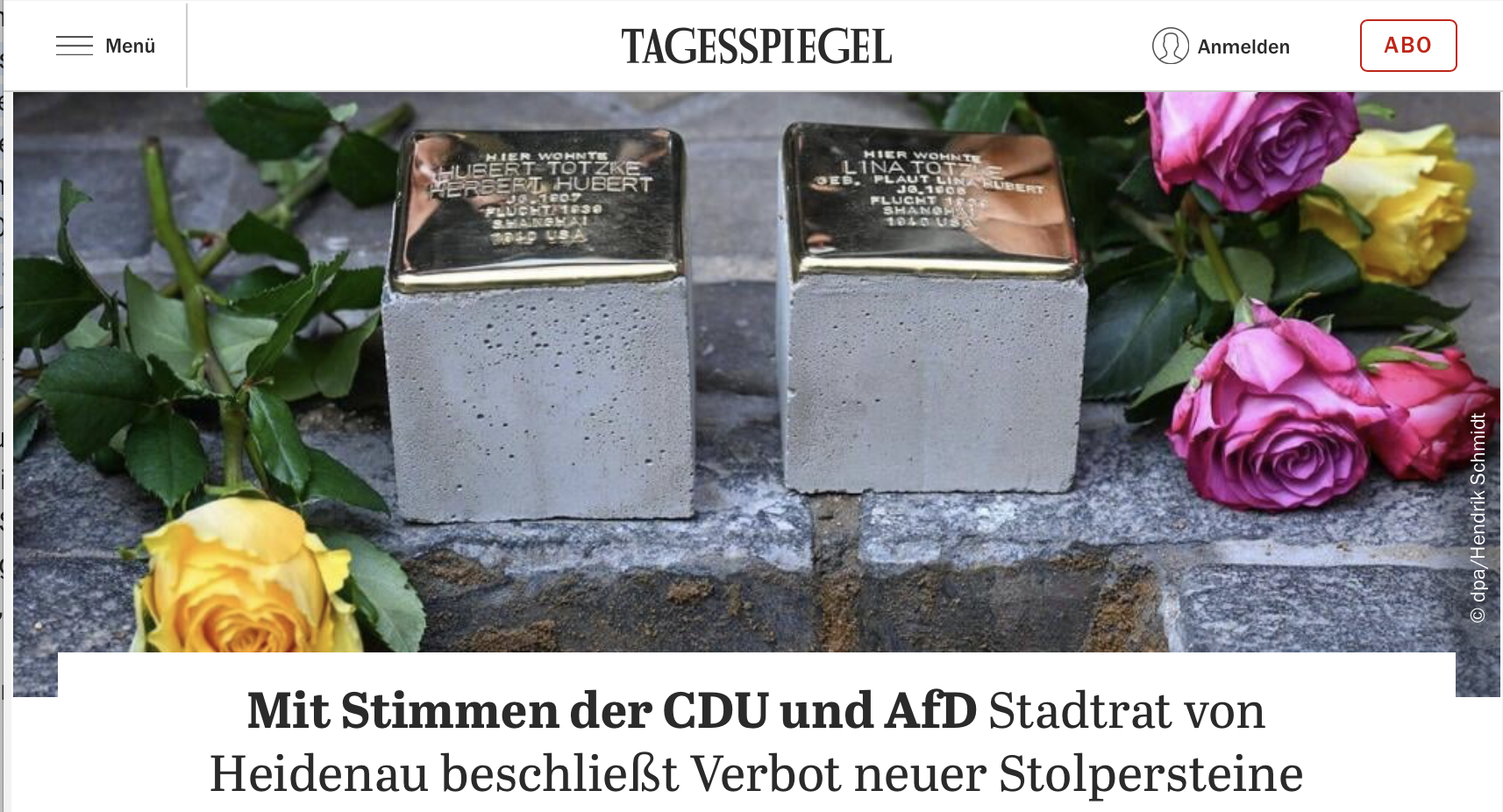 With votes from the CDU and AfD: Heidenau
town council passes ban on new Stolpersteine
*****
“In Saxony, a town council has spoken out against the laying of further Stolpersteine. The CDU and AfD tabled the motion jointly. “An absolutely unique occurrence,” criticises the head of the Stolperstein Foundation.
The town council in Heidenau, Saxony, has voted against the laying of new Stolpersteine on public pavements. This was reported by *Bild*. In the vote on a joint motion by the CDU, AfD and the BOD (Oberelbe Citizens’ Initiative for More Democracy), 13 councillors voted in favour of the ban, with six against and one abstention. The city administration confirmed the result to the dpa news agency.
The debate over the memorial sites was triggered by plans by the Alternative Culture and Education Centre of Saxony to lay seven new Stolpersteine in the town. There are currently five such stones in Heidenau. However, the city councillors from the CDU, AfD and BOD wanted to prevent this and instead create a central memorial area in a cemetery.
The reasoning given was that many local authorities view the installation of these stones in public streets with scepticism. “Although the ‘Stolpersteine’ are recognised as a project, their placement on pavements means that passers-by – consciously or unconsciously – walk over the names of victims or even step on them.”
The city council spoke out against a ban
The joint motion had already attracted criticism in the run-up to the vote, as it had been signed by both CDU and AfD politicians. In principle, the CDU has a ban on cooperation with the AfD. The city council recommended rejecting the motion: “Commemorating the victims of National Socialism and other tyrannies is a task for society as a whole,” the administration wrote in its justification. “It should take place in locations that are publicly accessible, visible within the cityscape and integrated into the everyday lives of residents.” However, on Thursday evening, a majority of city councillors did not follow the administration’s recommendation.
“I find it extremely worrying that democratic parties are supporting the motion,” Katja Demnig, managing director of the Stolperstein Foundation, told *Bild*. “This is an absolutely unprecedented development.”
Auschwitz Committee calls it a “scandal”
Christoph Heubner, Executive Vice-President of the International Auschwitz Committee, said in a statement: “This is a transparent and despicable attempt to once again drive the Nazi victims of Heidenau out of the town and consign them to where, in the AfD’s view, remembrance has long belonged: the cemetery.” He described it as a scandal that CDU MPs are “joining forces with the AfD on such despicable matters”.
The ‘Stolpersteine’ memorials have been in existence since the 1990s. These paving stones, which are usually funded by donations and bear the names of victims of National Socialism, are laid at the victims’ last known place of residence or work.”