March 26, 2026
By Robert Blakeley
Jacob Frank and Fredericka Rosenthal (LY4D-F9J, GCV3-234)

Jacob and Fredericka were married on December 2, 1879, in Meiningen, Thuringia, Germany. Jacob was 24 years old and Fredericka was 23. Fredericka was born in Mühlfeld, Bavaria while Jacob was born in Marisfeld, Thuringia. They were Jewish.
Jacob was born March 22, 1855. Jacob’s family had been in Marisfeld for three or more generations and his relatives lived there into the 1940’s, until displaced or killed by the Nazis. Marisfeld is as close to a Frank ancestral home as we are likely to find.
Jacob’s grandparents were Jacob Samuel Frank, born in 1764 in Marisfeld, and Thaya, who had been born in Schwarza, Thuringia. Jacob Samuel had 9 children between two wives, Thaya and Fradel. Thaya had 3 children, one of whom was stillborn. Her youngest child was Bär Jacob Frank, Jacob’s father. (Bär is pronounced bear and the word means bear, the animal.)
Bär Jacob Frank was born September 14, 1807, in Marisfeld. (In the middle of the Napoleonic Wars, 1803 to 1815). Bär hardly knew his mother, Thaya. She died sometime between Bär’s birth in 1807 and 1810. He grew up with Jacob Samuel’s second wife Fradel as his mother and with his two siblings and five half-siblings.
Bär was married to Jette Wertheimer on May 6, 1854, when he was 46. Jette (pronounced Yetta), was 32. She had been born July 16, 1822. The following year their son Jacob was born, apparently their only child. Grandfather Jacob Samual had died the year before, so Jacob never knew him.
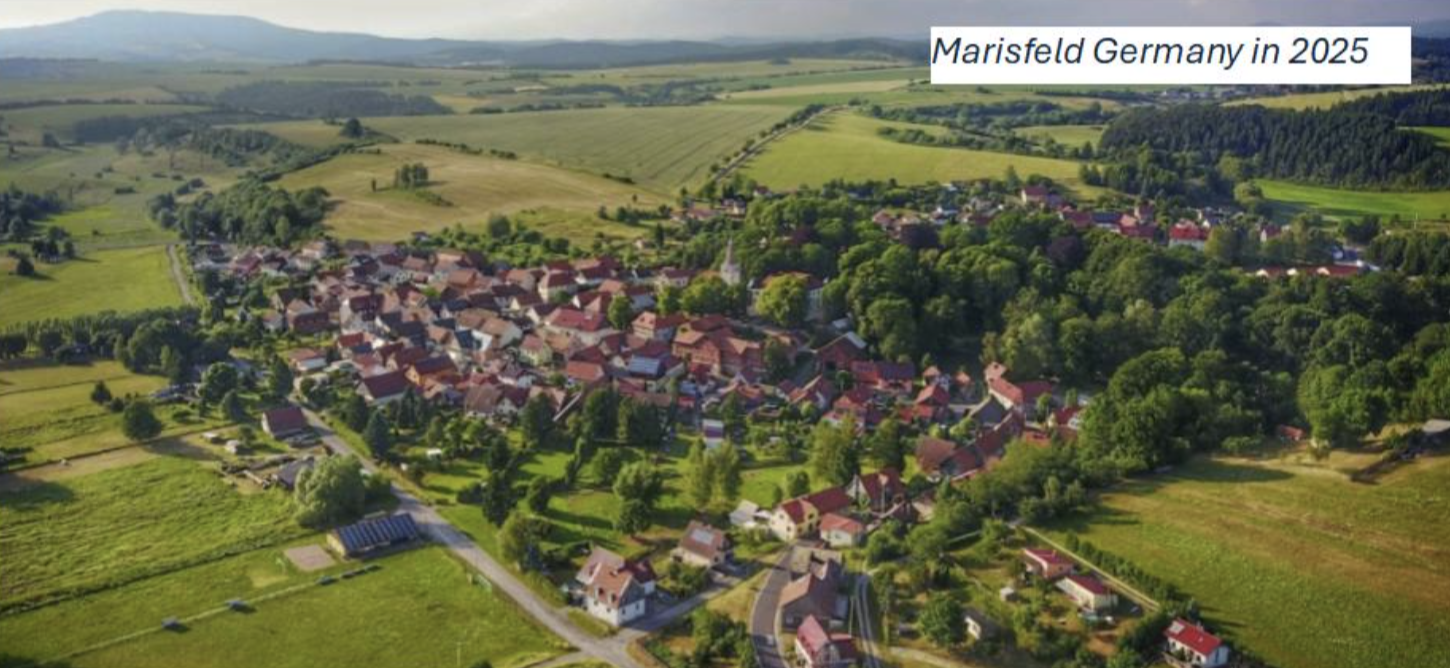 Marisfeld was (and remains) a tiny village in what is now the German state of Thuringia, just north of Bavaria. Jews had been allowed to settle there since 1697. By the 19th century one third of the inhabitants were Jewish. They mostly worked as livestock dealers, waggoners, or in farming.
When Jacob’s father Bär was born, Germany as a unified nation did not yet exist. Thuringia was a collection of separate dutchies and principalities. Between 1815 and 1866 Marisfeld belonged of the Duchy of Saxe-Meiningen, a member state of the German Confederation.
A new synagogue was built in Marisfeld in 1832, when Bär was 25. Bär and Jetta were likely married in that same Synagogue. The Jewish community also had a school building and a Mikveh. The Synagogue was used until the 1930s and was spared destruction by the Nazis because it had become private property.
The 1840s were roiled by regional economic struggles and demands for constitutional governments. The full-blown revolutions of 1848–49 (called the “Springtime of Peoples”) started in Sicily, spread to France resulting in the overthrow of Louis-Philippe, then the German states and Austian Empire. Bär Frank was in his early 40s. Residents of the German Confederation were dissatisfied by the lack of economic opportunity and political freedom. They advocated for German unification. The revolts were suppressed and the result was a severe, decade-long conservative backlash.
There was a regional economic expansion in the early 1850s, driven by the first wave of industrialization in the German states. The economy grew overall. However, wealth shifted from farming in the country to manufacturing in urban areas, leaving rural communities like Marisfeld behind. Around 1850 there were about 200 Jews living in rural Marisfeld. Jacob was born five years later. Then the general prosperity ended abruptly with the financial crisis of 1857. The political turmoil in Europe continued. In the 1860’s. Otto von Bismarck, the Minister President of Prussia, led a series of wars against Denmark, Austria, and France to unify the German states into the German Empire.
In Marisfeld there was a big fire in 1866. Many Jewish families moved from Marisfeld to neighboring towns such as Themar or Meiningen. These were larger towns and likely provided more opportunities. Bär died shortly after the fire, on December 17, 1866. Jacob was just 11 years old. By the late 1860s, only a few Jewish families remained in the village. Jacob was raised by his mother in a dwindling Jewish community.
Between in July 1870 and January 1871 France went to war against the Northern German Confederation and its allies (the Franco-Prussian War). The Prussians won. As a result, full German unification finally took place in 1871 under the Prussian King Wilhelm I and Chancellor Otto von Bismarck. Jacob and the rest of Marisfeld were now living in the new country of Germany.
By 1870, the Jewish population of Marisfeld had declined to 7 families. The town was primarily conducting local trade. Jacob’s maternal grandmother, Betti Kohler, died January 1, 1871, when Jacob was 15. Jacob and Fredericka Rosenthal were married about 9 years later.
Fredericka Rosenthal’s Great Grandfather was Gump Moses Rosenthal, who was born in 1734. He died sometime after 1817 in Mühlfeld, Bavaria.
Mühlfeld is about eighteen miles southwest from Marisfeld. It was first documented in 1196 and was located in the region of Grabfeld, southeast of the Rhön Mountains, situated on the border of what is now Bavaria and Thuringia. Today, Mühlfeld is a district in the town of Mellrichstadt. Mühlfeld, like Marisfeld, was a small farming village. Mühlfeld and Marisfeld were affected by the same regional politics and economics.
When Gump Rosenthal was born the broader Rhön-Grabfeld region consisted of small, mostly agricultural settlements governed by local nobles or ecclesiastical authorities. Mühlfeld belonged the Bishopric of Würzburg. In 1803, after the secularization of church territories during the Napoleonic era, the region passed to the Grand Duchy of Würzburg and then, in 1814, to the Kingdom of Bavaria. Bavaria joined the German Confederation in 1815. There was a small Jewish community in Catholic Mühlfeld.
Fredericka’s father, Nathan Rosenthal, was born in Mühlfeld June 5, 1817. Her mother was Yette Neumann. Yetta was born in Willmars, Bavaria on February 19, 1822. The 1840s brought the same economic struggles experienced in nearby Marisfeld. When the revolutions of 1848-49 erupted, Nathan Rosenthal was 31 and Yetta was 26. As elsewhere, the revolutions were eventually suppressed, leading to a period of politically repressive conservatism. By the 1850’s Industrialization was beginning in the larger urban cities, but Mühlfeld remained agricultural and its rural living standards changed slowly, at best.
Nathan and Yette were likely married about 1851 or1852 in Mühlfeld, three years after the uprisings. Nathan would have been about 34 and Yetta about 29. Nathan was a cotton weaver. Fredericka was the last of 5 children, born November 30, 1856. One of her siblings was a twin who died at childbirth.
Nathan was 56 and Yetta 49 when Germany was unified after the Franco-Prussian war. Fredericka was15. Like the Frank family, the Rosenthals were now living in a new country.
Although Jacob and Fredericka were married in Meiningen (December 2, 1879), they lived and bore their children in the Jewish community of Marisfeld. In the 1880’s Marisfeld overall had fewer than 500 residents. As an agricultural community, it was still struggling economically.
Jacob and Fredericka had four children:
- Bernhard (1880-1982)
- Olga (1884-1973, m. Bennett)
- Ilma (1885-1948, m. Schacht)
- Rosa (1892-1971, m. Gottheim)
Bernhard would later recall living in a town in Saxony that was surrounded by a wall, but there is no record of the family ever living in Saxony. There is a four-year gap between the births of Bernhard and Olga and a seven-year gap between Ilma and Rosa. Those are large gaps for the time, and such gaps are often explained by stillbirths or early childhood deaths. However, Fredericka stated in later official documents that she only bore four children.

In the late 1800’s there were large numbers of people leaving Germany for better opportunities in the United States and elsewhere. For families in small rural communities such as Marisfeld, the economic future must have appeared increasingly limited.
Fredericka and the children sailed for New York on the steamship S.S. Havel in 1892. They travelled in a second-class cabin and carried three pieces of luggage. They departed Bremen, stopped in Southampton, England, then continued onto New York City. They arrived on May 25, 1892. Ricka was 35 years old. Bernhard was 11, Olga 7, Ilma 6, and Rosa 11 months old. Jacob was 37 at the time. Jacob either came on another ship (sometime after Aug or Sept 1891), or there was a clerical error and he was omitted on the Havel manifest. Jacob listed his immigration date as either 1891 or 1892 in later documents. In 1892 Jacob had a cousin, Minnie Marks (nee Werthheimer), living with her family in Brooklyn. Minnie had immigrated in 1880 but there is no record of any contact between Jacob and the Marks in the U.S.
Fredericka’s father Nathan died on October 13, 1894, in Mühlfeld. Jacobs mother Jetta died seven months later on May 29, 1885, in Thelmar. Fredericka’s mother Yetta died the year after Nathan on November 4, 1896. Jacob and Fredericka were now both orphans.
When the family arrived in the United States, Benjamin Harrison was president. Later that same year Grover Cleveland was elected president. 6 years later war fever was sweeping the U.S. and the Spanish American War took place in 1898 under President William McKinley. Participation was voluntary and there is no record of the Frank family being involved in any way.
By June 1900, eight years after arriving in America, the family was living in Gloversville, a town in upstate New York. Because Frank is a common surname it is difficult to determine exactly where they lived in those previous 8 years. It is possible, perhaps even likely, that they were living in Gloversville during those years.
In 1900 Gloversville was the center of glove making for the country. This included both leather making and glove production. The Gloversville area made 57% of the gloves in the country that year. In 1905, about 82% of wage earners in the town worked in gloves or leather. Many of the factories were German-Jewish owned and employed immigrants from Germany. Those immigrants included the Frank family.

The Frank family was living at 92 E. Fulton St, which was one of the main streets in Gloversville. Jacob was listed as a cattle merchant. Bernhard (going by Ben) was now 18 and working as a salesman. Olga, 17, worked as a machine operator, likely a sewing machine and sewing gloves. Ilma worked as an end puller. (An end puller turned finished gloves right-side out and pulled the fingers to make them straight after sewing.) Rosa (going by Rose) was 8 and attending school. Interestingly, Willie LeVore, 20 years old, was boarding with them and working as a Typewriter (a typewriter operator). He is identified as their cousin. Willie had immigrated in 1890, two years before Fredericka and the children.

In 1901 the family moved to 114 North St. Jacob is listed in the Gloversville town directory as a Butcher. (The house, built in 1900, still exists). On September 17 the next year, the “The Gloversville Daily Leader” ran a story about a big party that Olga attended at 28 North St.
By June 1905 Ben, Olga, and Ilma had moved to Manhattan. Rosa remained in the North St. house with her parents. She was 15 and working as a bookkeeper. Jacob was 50 and Fredericka 48. William LeVore was still living with them, now listed as a nephew and working as a house painter.
In 1905, Ben boarded at 1586 First Ave in the Yorkville section of Manhattan. Olga and Ilma rented rooms from an older couple just four blocks south, at 1502 First Ave. Yorkville was a dramatic change from the small factory town of Gloversville. At the time, Manhattan had a population of about 2 million. Since the 1810s Yorkville had been a destination for German speaking immigrants and in 1905 it had a significant Jewish community. This included Ben’s soon-to-be in-laws, the Anhaltzers. Joseph Anhaltzer and his family, including Ben’s future wife Martha, lived at 406 E. 83rd St, just around the corner from Ben.
Olga was a sales lady and Ilma a laundress. Ben was a butcher and three others in Ben’s house were also butchers. According to what Ben told his son Leslie, Jacob wanted Ben to become a doctor instead. (There is a family story, handed down by Ben’s grandchildren, that Ben walked from Gloversville to Chicago to learn how to be a butcher. That is about 780 miles. A variation of the story said he walked to New York City, not Chicago, to be a butcher. That is about 190 miles.) Just three years earlier The Great Kosher Meat Boycott of 1902 was a significant protest by Jewish women in New York City against the rising price of kosher meat (prices were controlled by the Chicago slaughterhouses). There was a riot of some 20,000 protesters, mostly women. The meat boycott expanded beyond the Jewish community to other immigrant groups. It made national news. The boycott changed how the supply chain worked for meat in New York and that in turn affected Jacob and Bernhard’s jobs as butchers.
Ilma married William Schacht on May 14, 1907, in New York City. She was 21 and William was 22. They were married by the local alderman in a civil ceremony. (Aldermen were replaced decades later by the NY City Council.) They were married again on July 7, 1907, in a religious ceremony by Rabbi Krauskoff. William had been born in New York of German parents. He was a plumber, living at 3810 3rd Ave in The Bronx. Ilma was living at 1502 First Ave in Yorkville. Also in 1907, Olga married Solomon Bennett in New Jersey. Solomon had been born in Newburg, New York of English parents. He worked as a window dresser. Olga was 23 and Solomon 26.
Shortly after Ilma’s marriage, in mid-October, the financial crisis known as the Panic of 1907 began. This one was triggered by a failed attempt to corner the stock of the United Copper Company. This led to numerous runs on banks and trust companies. The stock market fell almost 50%. The panic led to financial contractions and bankruptcies which spread throughout the United States. The economic downturn affected Jacob and Fredericka up in Gloversville and their children who lived down in New York City.
A year later, on September 1, 1908, Ben married Martha Anhaltzer. Ben had moved to The Bronx and was living at 207 E. 158th St. Martha was living with her parents at 406. E. 83 St. in Manhattan. Martha and her mother Leopoldine were born in Vienna, Austria. Her father Joseph was born in Hungary but lived in Vienna when he married Leopoldine. Martha immigrated to NYC and the Lower East Side in July of 1895, about 4 years after her parents. She had been left with her aunt in Vienna when the rest of the Anhaltzer family immigrated in 1891.
Jacob and Fredericka’s first grandchild, Mildred Schacht (Ilma’s child), was born on April 14, 1908, and LeRoy Nathan Bennett (Olga’s child), was born November 3, 1908. Two months later, on Jan 23, 1909, grandson Bertrand Schacht was born (Ilma’s child). On July 5, 1909, Virginia Harriet Frank was born (Ben’s child), grandchild number 4. Over the following decade Ben and Fredericka would have thirteen grandchildren.
Sometime between 1909 and April 1910, Jacob and Fredericka left Gloversville and moved to The Bronx. The borough was experiencing rapid growth due to the expansion of elevated railways and subway lines connecting it to Manhattan. New York’s five boroughs had been consolidated into a single city only twelve years earlier, in 1898. In 1910 Jacob was 55 and Fredericka 54. They had been married 29 years. Did they move to be near their grandkids? We do not know. Olga and Sol Bennett, and their son Leroy, were living with them at 1019 Boston Road (near the 3rd Ave elevated). They were renting.

Solomon was working as a salesman. Ben had his delicatessen across the street at 1020 Boston Rd. Interestingly, the shop was across the street from the Young Men’s Hebrew Association. Soon thereafter they all moved to 586 E. 165th St, which is less than a block from their Boston Rd home and the delicatessen.
In 1910, Ben and Martha Frank were still living at 207 E. 158th St in The Bronx, about a 15-minute walk from Jacob and Fredericka’s house. Ben was working as a butcher in a market. William and Ilma Schacht were living at 2043 Washington Ave, also in The Bronx. William was working as a plumber in a plumbing supply house. Rose was now living with William and Ilma (not Jacob and Fredericka) and working as a saleslady in a glove store. Earlier she had been working at 995 Boston Rd as an operator (of what, we don’t know), close to Jacob’s home.
There was another financial contraction beginning in February 1910 (called the Panic of 1910-1911), producing another economic setback. More grandchildren arrived. Harriet Barbara Bennett was born Dec 5, 1910. Norman B. Frank, son of Ben, was born March 28, 1911. Harold Schacht, son of Ilma, was born June 21, 1911. Inez Frank, daughter of Ben, was born June 16, 1915.

Between 1911 and 1915, Jacob and Fredericka moved back upstate to Fultonville in Montgomery, N.Y., just eight miles from Gloversville. Fultonville was a small town on the Erie Canal. In 1910 it had a population of 812. Given their background, they may have preferred a small town. Or perhaps they had friends or connections in the area.
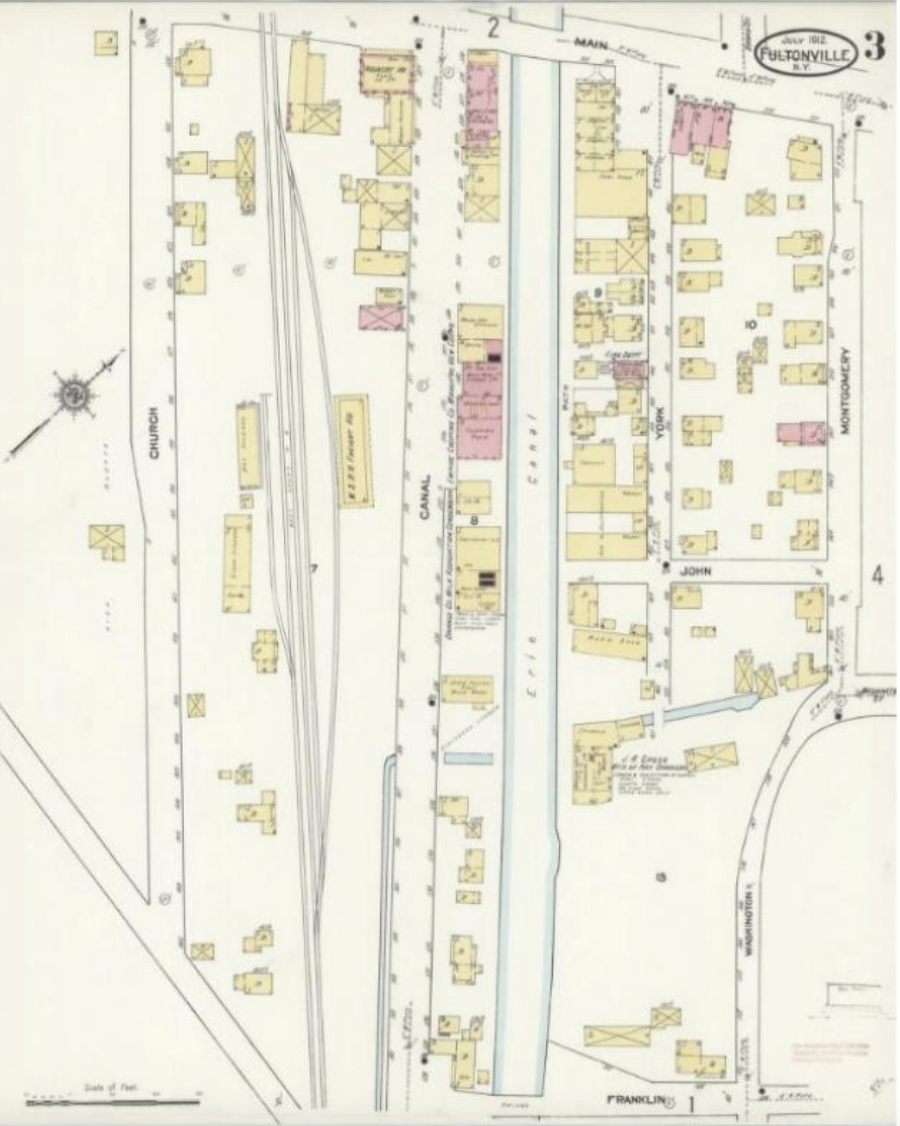
They lived on Canal St in Fultonville, between the Erie Canal and the railroad. Canal St is now called Erie St. Where the Erie Canal ran in 1915 is now the NY State Thruway (I90). (The Thruway, like the Erie Canal, charges a toll.)
Fultonville had been founded in 1824 in anticipation of the opening of the Canal. The Canal vastly reduced the costs of transporting people and goods across the Appalachians. The Erie Canal continued to be competitive with railroads until about 1902, but its commercial importance was in decline by the time Jacob and Fredericka moved to Fultonville.

At Fultonville, The Erie Canal ran near and parallel to the Mohawk River. Just across the Mohawk River was the town of Fonda. The two towns functioned as one entity. They were a transportation node for exporting freight from surrounding areas like Johnstown and Gloversville. In 1910 the town’s industries included a foundry, broom-making, and furniture manufacturing. The businesses on Canal St itself, in June of 1912, included a furniture manufacturer, a wood shop, 2 tailors, 2 barbers, 4 saloons, a printer, 2 machine shops, 2 coal sheds, an icehouse, a hay barn, and the Fire Department.
In 1915, while Jacob and Fredericka were in Fultonville, their children were living in The Bronx. Son Ben and his wife Martha were living at 4431 Third Ave in The Bronx. He was working as a Butcher. Solomon and Olga Bennett were living at 1049 Simpson St in The Bronx. Rose was now living with the Bennetts and working as a glove maker. William and Ilma Schacht also lived in The Bronx at 3814 Third Ave. Both Solomon and William were working as salesmen.
Grandson Joseph Schacht (son of Ilma) was born June 14, 1916, in The Bronx.
Less than a year later, in April 1917, the United States entered WW1 against Germany and Austro-Hungary. Woodrow Wilson was president and had won the presidential election based in part on his pro-neutrality platform. The entry into World War I caused a swift, severe suppression of German American culture. Some of this was self-censorship and some by government regulation. German nationals were required to register with police, be fingerprinted, and carry ID cards. Schools in New York banned the German language from the curriculum, and libraries removed German-language books. Many German Americans changed their names to sound more American and stopped speaking German in public. Jacob was 62 and not required to register for the draft. Ben was living with Martha at 4435 3rd Ave in The Bronx when he registered. Also registering in The Bronx was Solomon Bennett, now living at 874 Kelly St. William Schacht and his family were living at 39 Oakwood Ave in Bogata, New Jersey when he registered.
Rose married Charles Gottheim on October 22, 1917, in a civil ceremony in the municipal building in Manhattan. She was the youngest and last of her siblings to marry. Charles was in the army at the time but had been working as a salesman before that. He was born in New York City of Austrian parents. Rose was living at 1009 Kelley St in The Bronx at the time. Charles served in France in Company A of the 308th infantry. Company A was a unit of the famous “Lost Battalion” that was surrounded in the Argonne Forest in France from October 2-8, 1918. The battalion casualties were very high. Charles was discharged in April 1919. Rose may have been living with Charle’s parents and siblings while he was in the army.
Beginning in December 1917, and continuing through February of 1918, a powerful series of ice storms and blizzards immobilized railroad and river transportation on the east coast. Commerce was at a standstill. In NY City there were food shortages. Jacob and Fredericka had to deal with shortages in Fultonville as well. During this weather, Sidney Schacht (son of Ilma) was born in Bogota, Bergen NJ on February 3, 1918.
WW1 ended in November 1918. But on August 14th, 1918, the Spanish Flu arrived in New York. The flu spread rapidly throughout that state and the country. The epidemic was declared ended by November 16th, 1918. The mortality rate was high. In November in New York City were 147,000 cases which resulted in 20,608 deaths. All the Frank family members survived.
Leslie Frank (son of Ben) was born in The Bronx on May 23, 1919, about 6 months later. Leslie was the 11th grandchild.
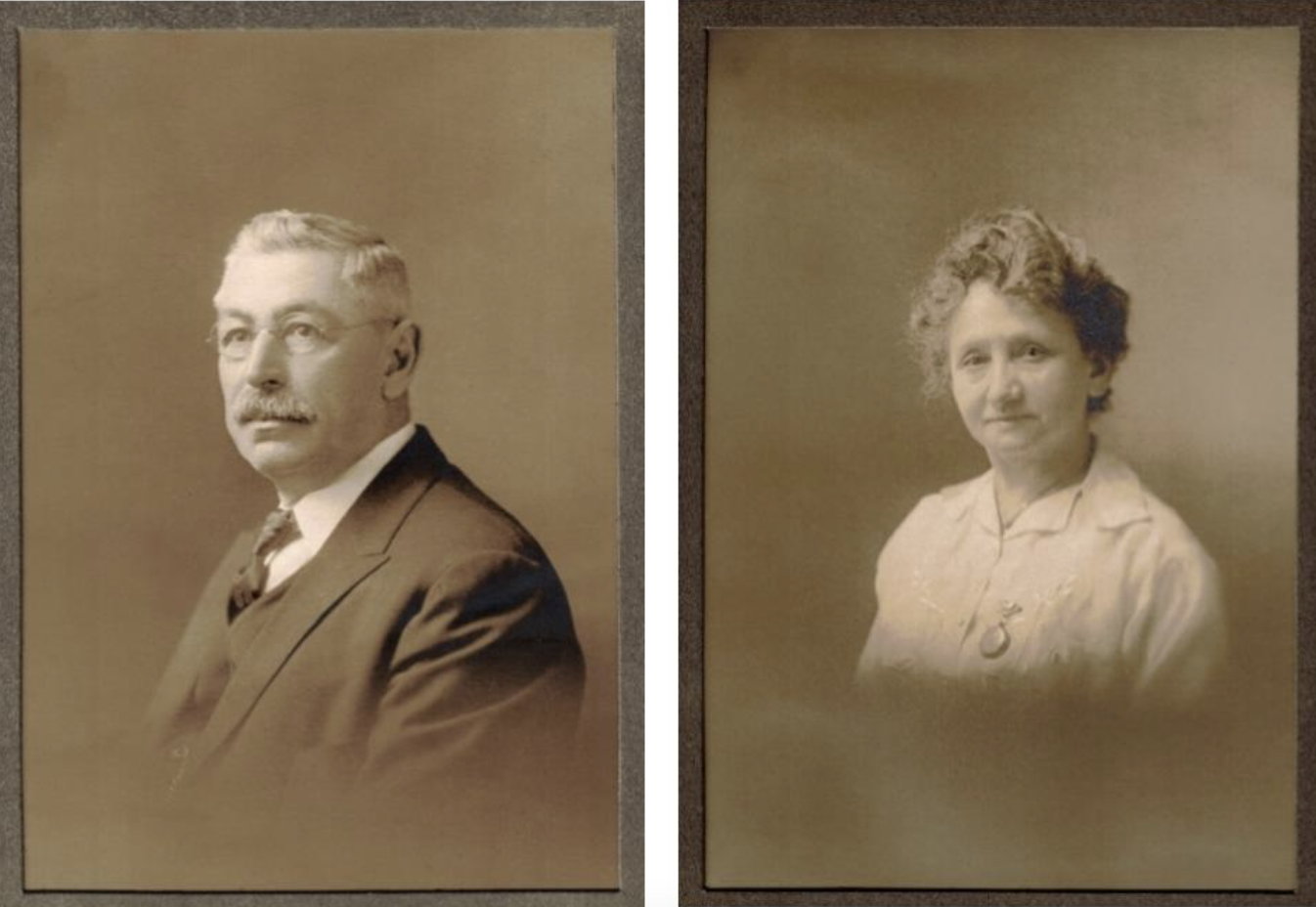
The roaring 20’s arrived and inaugurated decade of prosperity. Prohibition started on January 17, 1920. Women were guaranteed the right to vote in August 1920. Jacob and Fredericka were still living on Canal St in Fultonville. At that time, the village was a key transportation point for lumber from the Adirondacks and unloading coal. In nearby Fonda, the Johnstown & Gloversville (FJ&G) Railroad began adapting to the automotive age by introducing gasoline-powered coaches in 1922 and 1923, shifting away from steam power. (There is no story of Jacob or Fredericka ever owning a car).
In January 1920 Jacob was 64 and working as a Butcher. (It would be another 20 years before Social Security started making retirement payments.) Fredericka was 63. We don’t know if Fredericka took advantage of her new voting rights at the time. There does not appear to be any record of a Jewish community in Fultonville. The nearest synagogue was in Gloversville.
Ben Frank was working as a Butcher at 4435 Third Ave in The Bronx with his children Virginia, Norman, Inez, and Leslie. Ilma was living with her children Mildred, Joseph, and Sidney at at 442 Claremont Parkway in The Bronx. William is not listed as living with them. Olga and Solomon Bennett were also in The Bronx with their children LeRoy and Harriet, at 874 Kelly St. Charles and Rose Gottheim and their children Bertrand, Harold, Joseph, and Sidney were just a short distance away 886 Kelly St. Charles was working as a salesman of children’s dresses.
Grandson Donald Gottheim (son of Rose) was born on June 19, 1921, and Elaine Gottheim (daughter of Rose) was born on April 25, 1925. Elaine was the last grandchild.
By 1925, Jacob and Fredericka had moved from Fultonville back to The Bronx. They were cared for by their daughter Rose and her family at 2042 Grand Ave. Jacob was working as an order clerk in an optical store. The Bennett family had moved to Newark NJ between 1921 and 1922 where Solomon owned his own shoe store. Olga and Solomon spent about 3 years at 192 Ridgewood in Newark, then bought a home at 17 Harding Terrace. William and Ilma Schacht were again living together and with their children by 1925, living at 441 E. 170th St. in The Bronx. William was still a plumber, and Ilma was working as a nurse. Ben Frank and his family were still living at 4435 Third Ave, and he was still a butcher.
The 50th wedding anniversary of Jacob and Fredericka Frank was on December 1, 1929. They were living with Rose and her family. There was a party. At the celebration grandchild Harriet Bennett married Irving Rotter.
The stock market had crashed a month earlier, on October 29, 1929, and on the Frank anniversary the Great Depression was just starting. By 1932 the national unemployment rate was about 25%. Almost a third of New Yorker’s were unemployed. Hourly wages dropped by 50%. Franklin Roosevelt was elected president in 1933 and would famously create the New Deal. But the depression would last over 10 years, until 1942. Like millions of Americans, the Frank family faced hard times.
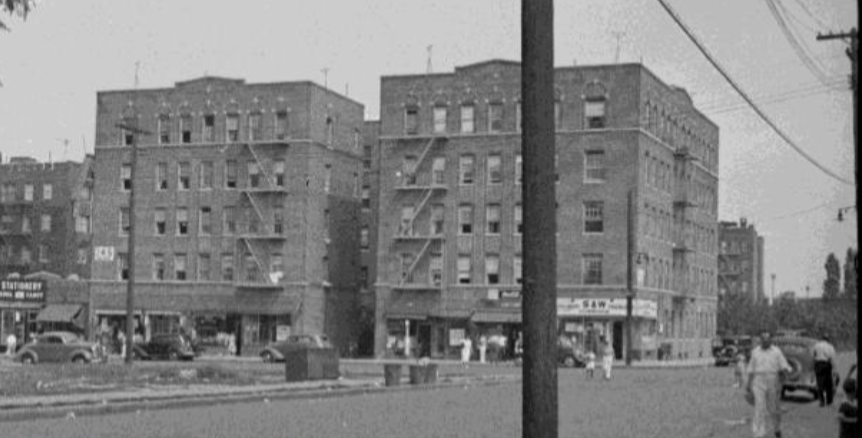
In April of 1930 Jacob and Fredericka were still living with Rose, her husband Charles, and Rose’s children Donald and Elane. Jacob was 75 and Fredericka 73. They were living at 665 Allerton Ave, in The Bronx. Charles was paying $65/month in rent. Jacob was retired. Charles was working as a foreman for a dress manufacturer. Rose was working selling infant’s wear.
Ben and Martha Frank were now living at 548 E. 183rd St in The Bronx with Martha’s aunt Emma. They were paying $40/month. Charles and Olga Bennett had taken in a lodger at 17 Harding Terrace. William and Ilma Schacht were still in The Bronx, but at 1195 Fulton Ave. They were renting for $45/month. William was still a plumber, and Ilma was still working as a private duty nurse.
Jacob died on November 26, 1934. It was the height of the Great Depression. He died of a heart attack at 79. He had been suffering from cardio-vascular disease for some 6 years. Jacob died at 933 E. 181 St at 5AM. This was an apartment building near where Ben and Martha lived. We don’t know why he was there. Jacob was buried in Mt. Carmel Cemetery in Queens the next day, on Nov 27. Jacob and Fredericka were married nearly 55 years.

Fredericka moved in with her daughter Ilma and Ilma’s children Joseph and Sidney at 1195 Fulton Ave in The Bronx. William was not there. (There is a family story that William left Ilma and Ben Frank brought her food, but we have no further details or dates.) In 1935 Charles and Rose Gottheim moved to Harrisburg, Pennsylvania (1031 Melrose St) with their children Donald and Elaine. Ben Frank and his family (Virginia, Norman, Inez, and Leslie) were living at 2280 Bathgate Ave in The Bronx. (Inez would marry Bernhard Hoffman in Dec 1935). Solomon and Olga were in Newark with their son LeRoy, his wife Sylvia, and their grandson Carter.
If the story of the 1930s was the Great Depression, the story of the 1940s was World War 2. Fredericka and her children would have been aware of the rise of the Nazi 3rd Reich in Germany and its anti-Semitic persecution of the Jews. They would also have heard the rumors of the death camps and seen the horrific
pictures at the end of the War. Both Jacob and Fredericka had numerous relatives that died in the Holocaust.
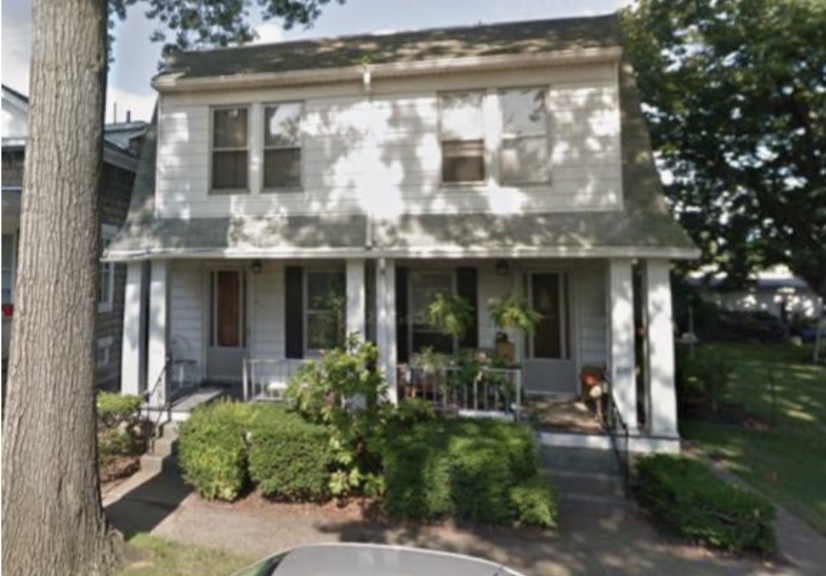
Ilma died on November 11, 1948, at age 63. Fredericka, now 93, moved back in with her daughter Rose. Rose was 58. They lived at 1031 Melrose Ave in Harrisburg. In May of 1950 Rose’s husband Charles was a Plant Manager in the Pennsylvania dress factory. Rose’s daughter Elaine worked for the Navy as a Computer Operator. In those days that was an operator of a mechanical calculator. Ben Frank (69 years old) and his wife Martha were living at 2175 Washington Ave in The Bronx. All their children were out of the house. Olga was living with her son LeRoy and his wife. Olga’s husband Solomon was not living with her (we don’t know when he died). Olga took on two boarders to help ends meet. Olga was 65.
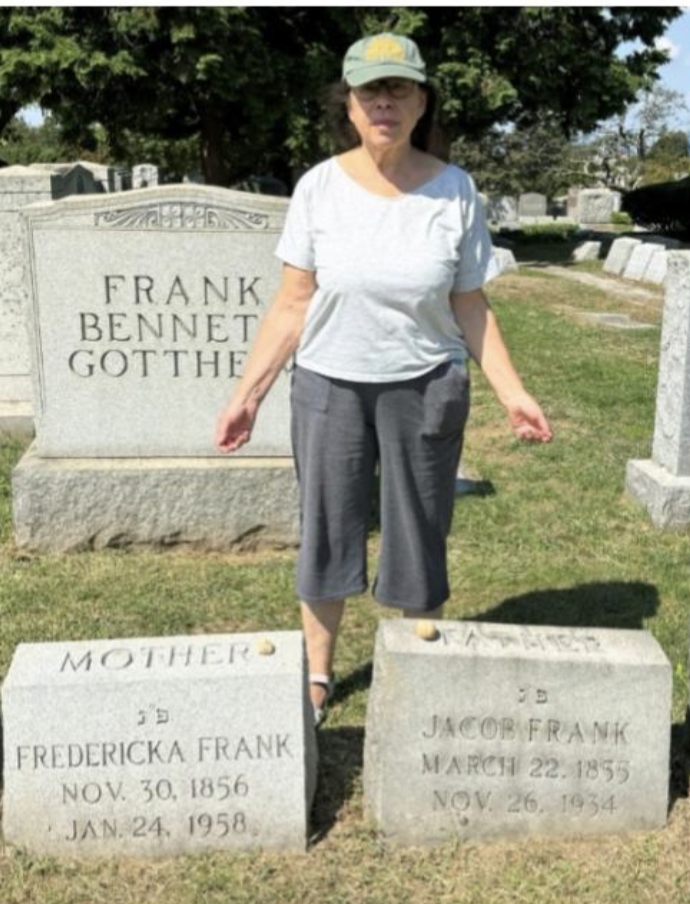
In 1953 Fredericka moved in with her daughter Olga (17 Harding terrace) and her grandson LeRoy and his wife and two children (Carter and Richard). She lived with them in Newark for 5 years before she too died in 1958. She died after a week-long illness on January 24, 1958. Until the illness, she was active and went out regularly. She liked to read and watch television, as well. Ben took his mother’s death very hard. She was 101 years old and had outlived Jacob by 24 years.
Fredericka is buried next to her husband Jacob, and near Olga, in Mt Carmel cemetery in Glendale Queens, NY.
https://www.familysearch.org/en/tree/person/sources/LY4D-F9J
https://www.familysearch.org/en/tree/person/details/GCV3-234

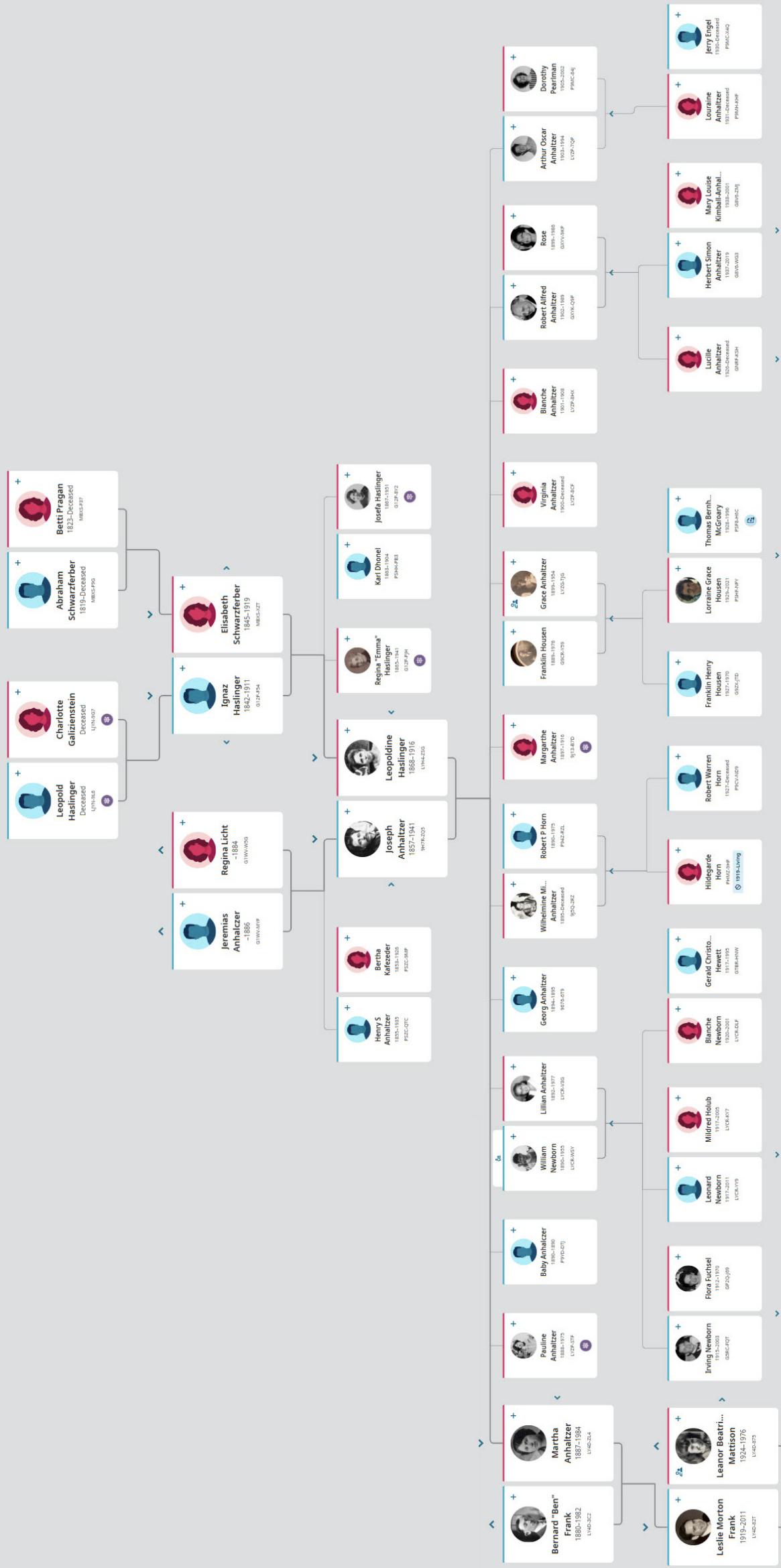
Joseph Anhaltzer and Leopoldine Haslinger (9H7R-ZQ5, LYH4-ZSG)

Joseph Anhaltzer was born on April 20, 1857, in Wármellék Hungary, which was incorporated into the town of Sárvár in 1900 (and which still exists). He was Jewish. At the time, Hungary was ruled by the Hapsburg Empire from Vienna.
In the 1860s, the Austrian Empire was defeated in the Austro-Prussian War and that led to the creation of Austria-Hungary, a dual monarchy where both countries had equal standing under a single monarch, Franz-Joseph. One of the results was that full emancipation was granted to the Jews in 1867. Civil registration was administered through recognized religious communities, including the Jews, that handled taxation and communal governance.

Because of that emancipation, the Jewish population of Vienna grew rapidly. At some point Joseph also moved to Vienna where he met and married Leopoldine Haslinger. They were married on March 13, 1887. Jews were about 10% of the population of Vienna at this time, numbering just under 100,000. Joseph was 29 years old and Leopoldine was 18. Leopoldine was born in Vienna on Sept 1, 1868. The marriage record from the Viennese Jewish community lists Joseph’s parents as Jeremias Anhalczer (who was a freight shipper) and Regina Licht. However, they were deceased when Joseph married. (Regina died in 1884 and Jeremias sometime after Regina). Joseph had at least one brother named Samuel. Leopoldine’s parents were Ignaz Haslinger (a merchant from Budapest) and Elisabeth Schwarzfärber. In the Vienna city directory of 1887 Ignaz is listed as a clothing retailer. They had three known children, Regina (1865-1941), Josefa (1867-1951) and Leopoldine (1868-1916). Ignaz and Elisabeth died in Vienna in 1911 and 1919 respectively, long after Leopoldine had immigrated to the U.S.
The Anhaltzer name in documents from Wármellék Hungary was spelled Anhalser, in Vienna as Anhalczer, and in the U.S. as Anhaltzer. Joseph appears to sign his Vienna marriage record as Anhaltzer. Also, Joseph is going by the given name Moriz in Europe but in the U.S., he went by Joseph.

Joseph and Leopoldine were married in the Stadttempel (City Prayer House) Synagogue also known as the Seitenstettengasse Temple. It’s located in the old Inner City neighborhood. It is and was Vienna’s main Synagogue which followed the moderate Viennese rite rather than being strictly Orthodox. It is the only pre-WW2 Synagogue that survived the Nazis. (A commemorative glass, made at the time of the synagogue’s dedication in 1826 and etched with a detailed image of the synagogue’s interior, is now in the collection of the Jewish Museum in New York.) The marriage witnesses were Leopoldine’s father Ignaz and someone named Frank Serafsa. (Aka Franz Schaffa). The Rabbi’s name was Crozold Wollner (the handwriting is unclear in the record). The Stadttempel is an active Synagogue today. In 2025 Jews are 1% of Vienna’s population.

Starting with the emancipation of 1867, Vienna’s Leopoldstadt district (district 2) developed into the center of Vienna’s Jewish life. The Jewish population in this district soon represented half the district’s population and Jewish residences expanded into the adjacent districts of Brigittenau and Alsergrund. The Jews living in these areas made up most of Vienna’s Jewish population. These areas were largely populated by the lower or middle classes: Manual laborers, craftsmen, small-scale businessmen, and traders. (Wealthy Jews lived for the most part in the city center, the Innere Stadt, and the far western and far northern suburbs of Döbling and Hietzing.)
However, Joseph was living at VIII Lerchenggasse 17 when he was married. This is in the district just west of Leopoldstadt. It appears that Joseph was living with the Haslinger family at the time he married Leopoldine. A “gasse” is an alley or small street. VIII means the 8th district (which is called Josefstadt). “17” is the specific address. Today the house is gone, and the lot appears to be a backyard to something. Their house was about a 40-minute walk to the Stadttempel Synagogue so it’s reasonable to think the Stadttempel was not their regular synagogue.
Joseph and Leopoldine had 12 children:
- Martha (1887-1983, m. Frank)
- Pauline (1888-1975)
- Unnamed (1890-1890)
- Ottilie (Lilly, 1892-1977, m. Newborn)
- Georg (1894-1895)
- Wilhelmine (Minnie, 1895-unknown, m. Horn)
- Margarthe (1897-1916)
- Grace (1899-1954, m. Housen)
- Virginia (1900-unknown)
- Blanch (1901-1908)
- Robert Alfred (1902-1989, m. Rose)
- Arthur Oscar (1903-1994), m. Dorothy Pearlman)
The couple and Leopoldine’s father Ignaz were living on Lerchenggasse when their first child Martha was born on September 7, 1887. (Yes, that’s about 6 months after they were married.) The attending midwife was Heinecke Maurer, who was living in the same building. Note also that one of the witnesses listed on Martha’s original birth record is Simon Schwarzfärber. Simon is the brother of Leopoldine’s mother Elizabeth. Simon is also the grandfather of Ignatz Ferber. Ignatz is Virginia Frank’s husband and Martha’s future son-in-law. Virginia Frank is Leopoldine’s granddaughter. Simon was living in the17th district, Hernals.
Daughter Pauline was born the next year, September 9, 1888. They used the same midwife, Heinecke Maurer, who was also a witness that time. The other witness was Josafine (aka Josefa) Haslinger who was Leopoldine’s sister. She was also living at Lerchenggasse 17.
On December 9, 1890, a male child was born but he lived only 2 days. He was unnamed. At that time Joseph and Leopoldine were living in Klosterneuberg at Bürgerstrasse 26. Klosterneuberg was just north of Vienna at the time (it’s now part of Vienna). The midwife was Bette Denk. About three months later the family left for the United States.
On March 13, 1891, Joseph, Leopoldine, and their daughter Pauline arrived in New York City. Joseph’s older brother Samuel (who went by Harry in the U.S.) and his wife Bertha had immigrated to New York City three years earlier in 1888. Joseph was 33 and Leopoldine was 22. Pauline was 2. Martha, who was 3, remained in Vienna with her Aunt Regina Haslinger. Martha arrived in New York on July 12,1895 when she was 7 years old. She was accompanied by her aunt Regina (who was 29 and called herself Emma in the U.S.). Martha fondly remembered being with her aunt and going to the Viennese cafes to have tea “mit Schlag” (mit Schalgsahne, with whipped cream) and pastries. Martha said that she was brought to America to help care for the children and found she had new siblings. She did not like having to leave that Viennese life and resented being called “greenhorn” by this new and expanding bunch of children. On top of that, her father told her she did not need further schooling.
Emma would cross the Atlantic and return to the U.S. five more times between 1904 and 1936. She would be a continuing presence in the lives of Leopoldine’s and Martha’s children.
Joseph and his family lived through much of New York’s modern history. In 1891 the population of New York was about 1.7 million people, many more than his hometown of Wármellék or of Vienna when they left that city. Joseph and Leopoldine arrived in New York at the end of the Gilded Age. In 1891 Benjamin Harrison was President of the United States. Because of industrialization, American wages and job opportunities were much higher than those in Europe. As a result, there was an influx of millions of European immigrants.

There was massive economic growth (and economic disparity) and the rise of industrialists such as Andrew Carnegie, J.D Rockefeller, and Jacob Schiff. However, in May of 1893, just two years after Joseph and Leopoldine arrived, a stock market crash led to the Panic of 1893 which in turn led to an economic depression second only to the Great Depression of the 1930’s. It lasted several years. Unemployment in New York soared. Joseph was a house painter. (His brother Henry originally had a house painting business, but it looks like he passed that business to his brother Joseph). The depression would have impacted Joseph’s painting business.

In 1892 Joseph, Leopoldine, and Pauline lived in a tenement on the Lower East Side at 120 E. Houston at the corner of 2nd Ave. (In 2024 this is the location of the First Street Green Cultural Park. The building was demolished when the City widened Houston St. in the early 1930’s) Joseph’s brother Henry and Henry’s wife Bertha lived a block away at 226 Christie St. Between 1880 and 1924, 2.5 million Ashkenazi Jews from the Russian Empire, Kingdom of Romania, and Austria-Hungary came to the United States and nearly 75 percent took up residence on the Lower East Side. When a new Jewish immigrant first set foot there, he or she stepped into a Jewish world. The New York Times proclaimed Second Avenue from Houston to East 10th Street “The Hungarian Broadway” for the sheer number of Hungarian restaurants to be found there.

However, for all the comfort of this shared heritage, the Lower East Side was still a very difficult place to live. By the year 1900, the district was packed with more than 700 people per acre, making it the most crowded neighborhood on the planet. Housing was bad and disease rampant. Martha remembered that women who would not get abortions would throw newborns out the windows of the tenements onto the building’s trash heap.
Ottilie, who later went by Lilly (or Lillian), was born at 120 Houston November 25, 1892, shortly before the Panic of 1893. Georg was born March 16, 1894. The family had moved to 132 E. Houston. Georg died a year later on April 30, 1895, at the Wellers Parkes Hospital. He died of Diphtheria complicated by Pneumonia. Martha arrived from Vienna in July. Wilhelmine, who went by Minnie, was born later that year. She was born on Dec 3, 1895.

On March 21, 1897, Margarthe (called Minnie) was born. She was the sixth child. In early 1896 the family moved uptown to 406 E. 83rd St, leaving the difficult conditions of the Lower East Side. They would remain at that address for many years.
Joseph had become a naturalized citizen on Feb 8, 1897, a month and a half before Margarthe was born. The witness was his brother Henry Anhaltzer now living at 324 E. 14th St. Joseph was a house painter. Henry was working in gas lighting.
The Spanish American war began the next year, in April 1898. The city’s newspapers, like the New York Journal and New York World, were key players in the “yellow journalism” that influenced public opinion in favor of war and then sensationalized the conflict. Participation was voluntary. New York provided a substantial number of troops. Joseph did not volunteer.
Also in 1898, New York became what it is today with the consolidation of the 5 boroughs into one municipality. The consolidated city had a combined population of 3.4 million people. By 1900 it had become the capital of national communications, trade and finance, and of both popular culture and high culture. Jewish workers immigrating from Southern and Eastern Europe expanded the labor force until World War 1. In the first decade of the century, Jacob saw the subways and the Williamsburg bridge open. Macy’s and Gimbal’s opened. The Coney Island amusement parks opened. The NY Highlanders baseball team was established, later to be called the New York Yankees. Vaudeville was the top entertainment venue for both the well-off and the working class.
Daughter Grace was born on June 5, 1899. In June of 1900 the family was still renting at 406 E. 83 St. Joseph was still a house painter. He and Leopoldine had been married 13 years. Joseph was 43 and Leopoldine 31. Martha was 12 and Pauline 11. Both were reported to be in school. Lilly (Ottilie) was 7, Minnie (Wilhelmine) was 4, Margaret (Margarthe) 2, and Grace was 11 months.
Later that year Leopoldine with Margaret and baby Grace sailed to Europe, presumably visiting her parents and other relatives. They sailed back to the U.S. from Bremerhaven in September of 1900. Their ship was the SS Friedrich der Grosse and the return trip took 10 days. Leopoldine was pregnant with her daughter Virginia on this trip. Virginia was born on Dec. 28. 1900. It’s likely she died at or soon after birth.
The Anhaltzer apartment on 83rd St. was in the Yorkville section of Manhattan. It had been a destination for German speaking immigrants since the 1880’s. By 1900, many German and Austro-Hungarian immigrants from the Lower East Side had also moved to Yorkville. 86th St was the central portion of Yorkville with many German shops, restaurants, butchers, and bakeries. These tended to be Prussian Germans. The Austro-Hungarians tended to cluster around 79th St. with restaurants and stores there importing goods from Hungary.

The Great Kosher Meat Boycott of 1902 was a significant protest by Jewish women in New York City against the rising price of kosher meat (it had gone from 12 to 18 cents per pound, a huge increase at the time). Leopoldine would have participated in that boycott. On May 11, 1902, around 400 kosher butchers on the East Side of New York organized a boycott of the Chicago meat trusts to pressure them to lower the cost of meat. However, the trusts were too powerful, and the butchers ended their boycott. In response, Jewish women in the Lower East Side held a massive protest. On May 15, 20,000 protesters, mostly women, took to the streets butcher shops were attacked. The boycott spread city wide. In the weeks following the riot, almost all purchases of kosher meats ceased. The meat boycott expanded beyond the Jewish community to other immigrant groups. The police were brought in and the boycott became ugly and more violent. The butcher shop owners joined the protesters on May 22. Prices dropped on June 9. It made the national news. (The kosher meat boycott served as an example for future protests, including a strike in 1904 to fight rising rents and the New York Shirtwaist Strike of 1909).
On June 7, 1902, Robert Alfred was born followed by Arthur Oscar, born Oct 25, 1903. Arthur was the last of the children to be born. In 1905 Martha was 17 and employed as a “Typewriter”, a skill she apparently learned while attending night school. (A Typewriter was someone who operated a typewriter). Pauline was 16 and working as a dry goods packer. Lillie, Minnie and Margaret were in elementary school. Grace and Blanche were in kindergarten.
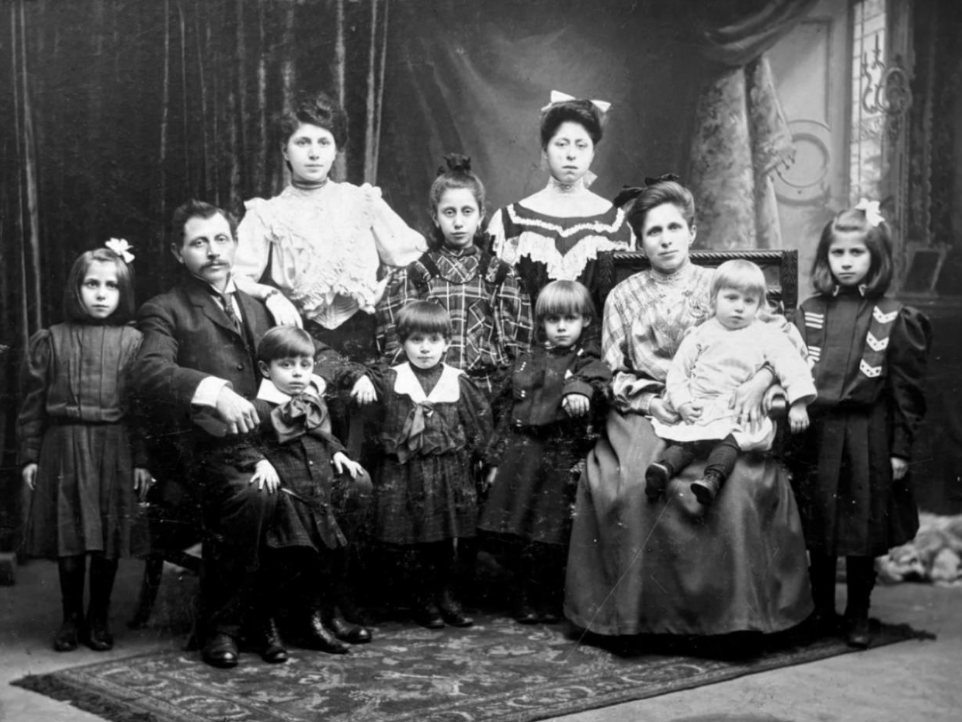
Then came the Panic of 1907. It was a severe economic contraction triggered by a failed attempt to corner the stock market. It exposed weaknesses in the banking system and that ultimately led to the creation of the Federal Reserve System.
Daughter Blanche died the next year in the evening of August 30, 1908. She died at home of Double Pneumonia complicated by Myocarditis. She was just 7 years old.
Martha married Bernhard Frank a week later, on September 6, 1908. In 1905 Ben had been living around the corner from the Anhaltzers. Ben was a butcher. There is a story Martha told about how she married Ben. Martha liked to say Ben “won” her in a poker game. Ben was a gambling buddy of Martha’s father Joseph. Joe put Martha up as ante for a bet and Ben won the hand. When Martha heard this, she accepted the offer to get out of the house. Martha moved into Ben’s apartment at 207 E. 158th St. in The Bronx.
According to family stories, Martha did not like her father. She said he was a drinker and a gambler. Martha told her granddaughter Valerie that on her marriage night, Martha did not know what to expect. She ran home and Joseph slapped her and told her to go back and do her wifely duty. Martha’s son Les remembered Joseph as a hard man.
By 1909 brother Henry and his wife Bertha had moved to Pittsburgh, PA. He became a chemist. Henry received at least ten US patents for various chemical processes and other inventions. In April of 1910 Joseph and Leopoldine had been married 23 years. Joseph was 58 and Leopoldina was 41. They were still renting at 406 E. 83rd St. Martha had married and moved out of the house, but Pauline (22), Lillian (17), Minnie (14), Margaret (13), Grace (10), Robert (7), and Arthur (6) were all there. Pauline was working in a steel wool factory. Lilly had quit school and was working as a clerk at an addressing company. The rest of the children were in school.
The Panic of 1910-1911 produced yet another economic setback but New York City recovered relatively quickly this time. Between 1910 and 1920, social reform movements gained political traction, taking on issues such as women’s suffrage, labor rights, and the welfare of the rapidly growing working class. On March 15, 1911, a fire broke out on the top floors of the Triangle Shirtwaist factory. 146 garment workers died horribly. Most were Jewish or Italian immigrants. The outrage from the fire spurred the growth of the garment unions and the long participation of Jews in those unions. Leopoldine’s sister Emma worked in the garment industry as an examiner of embroidery. Both Robert and Arthur would later have jobs in the industry.

In terms of politics, Joseph was a registered Democrat in 1914 and remained a Democrat for the rest of his life. (Pauline would also become a Democratic voter). New York City politics in the early 1900’s was dominated by the Democratic Tammany Hall political machine under Charles Murphy.

Between April of 1910 and early 1911, the family moved to 325 E. 83rd, just up the block from their residence at 406 E. 83rd St. (Interestingly, a witness for Joseph’s petition for citizenship in 1897, Julius Bloom, had also lived at that address.) On Nov 7, 1913, daughter Lillian married William Newborn (originally Neugeborn). He was 23 and she was 21. As an adult, Lillian is reported to have had quite a strong personality. William had immigrated from Hungary in April of 1910 and was living with the Anhalzers by Oct 2, 1913, when he made his citizenship declaration. The couple were married in the Orthodox Chebra Kadishe Talmud Thora Synagogue at 127 E. 82nd St. by Rabbi J. Benjamin Schwartz. (It seems likely this was also Joseph’s Synagogue). William and Lillian’s son Irving was born on January 25, 1915. They were still living with Lillian’s parents and siblings Pauline, Minnie, Margaret, Grace, Robert, and Arthur. It must have been crowded. Pauline was a saleslady and Minnie a stenographer. Grace was in high school and Robert and Arthur in elementary school. William Newborn was working as a salesman.
Joseph and Leopoldine had 13 known grandchildren. Martha had born Leopoldine’s first grandchild, Virginia Harriet Frank, in July 1909 and Martha’s son Norman Frank was the second grandchild, born in March 1911. Grandson Irving Newborn (Lillian’s child) was born in January 1915. Granddaughter Inez Frank (Martha’s third child) was born in June 1915.
The next year brought tragedy to the family. Both Leopoldine and Margaret died. Margaret died at age 19 on May 10, 1916, and Leopoldine died five days later on May 15, 1916. Leopoldine was 47 years old. They both died at home of Pulmonary Tuberculosis (TB). Margaret had been ill for about 2 years and Leopoldine for 1 ½ years. It appears that Leopoldine may have caught the disease from her daughter. Joseph and Leopoldine lost 5 of their 12 children.
Shortly after the death of Leopoldine, Lillian and William moved down the block to 526 E. 82nd St., apt. 10. Their second son Leonard Newborn was born there in 1917. In April 1917, the United Stated entered WW1against Germany and Austro-Hungary. Most Americans were against “foreign entanglements”, and Woodrow Wilson had won the presidential election based in part on his pro-neutrality platform. Since 1914 some Austro-Hungarian immigrants had been for and some against Germany and Austro-Hungary. This led to tensions with other New Yorkers, but the American entry into the war pretty much silenced those who favored Germany and its allies. Still, there were many in the country who were fearful of the “enemy aliens”. To avoid the prejudice, many individuals and businesses anglicized their Germanic names. We do not know what Joseph or his children thought about the war, but they would have been very aware of the tension in their community. Joseph was 60 when the war broke out and too old to participate. William became a citizen in March 1917 and registered for the draft in June. It looks like he did not serve in the war. The war ended in November 1918.
Beginning in December 1917, and continuing through February of 1918, a powerful series of ice storms and blizzards immobilized the railroads on the east coast. The Hudson River froze over and shipping into and out of New York City stopped. This led to shortages of food and fuel in the City for those months. Then on August 14th of 1918 the Spanish Flu arrived in New York City when a Norwegian ship with 10 infected passengers docked in the city’s harbor. That was not the only ship with infected passengers. By September there were over 100 cases in the city. 4 days later there were over 300 cases. On October 4 there were 1,000 new cases, bringing the total to about 4,000. On October 19 there were 4,875 new cases on that day alone. It appeared the epidemic was abating by November. The epidemic was declared ended by November 16th, 1918. At that time there had been 147,000 cases in NY City which resulted in 20,608 deaths.
The next month, on December 24, 1918, daughter Minnie married Robert Horn. Robert Horn was born Nov. 17, 1890 in Ohrdruf, Germany and arrived in NYC on July 29, 1917, while the U.S was engaged in WW1. Robert and Minnie were married in Manhattan in the Municipal building in a Civil ceremony. Minnie was 23 and Robert was 28. Robert was living at 230 E. 82nd St. at the time he was married. Grandchild Hildegarde Horn was born about 6 months later on July 22, 1919. Grandson Leslie Frank (Martha’s son) was born a few months earlier on May 23, 1919.
In January 1920, Joseph was 62 and listed as a Home Decorator, living at 325 E. 83rd St with four of his children. Pauline was 31. Grace was 20 and teaching art at a public school (PS160 and then PS 20 in 1922, both on the Lower East Side). Robert, 17, was an embroiderer in a factory, and Arthur was an errand boy for a milliner at 16. Grandchild Blanch Newborn was born in October 1920 (Lillian’s child, named for her sister Blanch who died in 1908). Lillian and William (who was now a streetcar conductor), were still living at 526 E. 82nd. Robert Horn (who was a facilities and boiler mechanic, called a “fireman”) and Minnie lived a few blocks north at 123 E. 88th St. Ben and Martha Frank were in The Bronx at 4435 Third Ave.

In 1920 the population of New York City was over 5 ½ million. With the 20’s came the post WW1 economic boom and the “Roaring Twenties” with all its wealth and glamour (for some). The Jews were about 29% of the NYC population and it was a period of economic growth for them. They also faced rising anti-Semitism and discrimination. There was a push towards Jewish assimilation, with a growing number of individuals seeking to integrate into mainstream society. Prohibition started January 17, 1920. It brought an increase in organized crime. Jewish and German groups had a traditional culture that included alcohol consumption, so many saw prohibition as an infringement upon that culture. Prohibition advocates often used anti-immigrant and anti-Semitic rhetoric, associating alcohol consumption with German, Irish, Catholic, and Jewish Americans. In 1921 the U.S. slammed the door shut on immigration when they passed the Emergency Quota Act. The Act was a result of exaggerated fears about the number of immigrants from Southern and Eastern Europe, fears of radical ideologies, antisemitism, and broader fears about social change.
It was a time of change. In January 1920, Luella Bates became the first woman licensed as a truck driver in NY. Women were guaranteed the right to vote in August 1920. In 1922, less seriously to us, a prolonged riot broke out when groups began forcibly removing and breaking straw hats of people who had failed to stop wearing them after the socially acceptable date of September 15. In 1925 the Rivoli became the first air-conditioned theater. The first radio station began broadcasting from Herald Square in 1925 and the first long-distance television transmission took place in NYC in 1927. The Holland tunnel, running from New York to New Jersey, opened in November 1927. Also in 1927, Charles Lindbergh (an antisemite) was celebrated with a massive parade for his flight across the Atlantic. The first “talkie” movie The Jazz Singer opened. The first color television demonstration took place in NYC 1929. Joseph and his children were part of and living through this cultural shift.

On August 28, 1923, Leopoldine’s sister Josefa (now Josafine Dhonel) arrived in NYC from Austria for a visit. A few months later, in July of 1924, Joseph went to Europe to see relatives in Hungary, Austria, and Romania. We do not know the names of relatives he visited. At the time, a steerage ticket cost about $30 (about $550 in 2025 dollars) and a second-class ticket was about $260 (about $4,700 in 2025). We do not know for sure what class he traveled in, but it was likely second class. He returned to the U.S. 3 months later on October 24, 1924, on the ship SS George Washington. (He was processed through Ellis Island). His Brother Henry went to Europe and returned via Rotterdam on August 25,1928.

Between 1923 and 1924, Robert Anhaltzer married Rose. Rose was an elementary school teacher like her sister-in-law Grace Anhaltzer. Robert was a butcher. He was 21 and Rose was 24. They were living with Joseph in 1925.
On March 13, 1925, Minnie’s husband Robert Horn became a US citizen. (He and Minnie registered to vote at the next opportunity, on Oct. 7, 1925, as Republicans and remined Republicans throughout the Great Depression.) The June 1925 NY Census shows Grace Anhaltzer had moved out of her father’s house and was living with her sister Minnie and Robert Horn at 123 E. 88th St.
Grace married Frank Housen on July 30, 1925, in a ceremony at the Municipal Building. The witnesses were Grace’s brother Arthur Anhaltzer and Florence B. Pettigrew, Frank’s sister. Grace was 26 and Frank was 36. Frank was born in NY City. This was his second marriage. His first wife had died in 1920 and left Frank with a daughter and two stepchildren. Frank was not Jewish. According to Martha’s son Les Frank, Joseph disowned his daughter. He draped her picture in black, treating her as dead. He did not speak to Grace or acknowledge her existence. Martha never forgave Joseph for that. Thereafter, Martha refused to have anything to do with religion. However, Herbert Newborn, Lillian’s grandson, recalls that Minnie’s husband, Robert Horn, was also not Jewish. No disowning story survives about Minnie and Robert. Frank Housen was a butcher (like his brother-in-law Robert) and eventually owned his own butcher shop.
Granddaughter Lucille, daughter of Robert Anhaltzer, was born in 1926. Grandsons Robert Horn (Minnie’s child) and Frank Housen Jr (Grace’s child) were both born in 1927. Lorraine Housen (Grace’s child) was born in 1929.
Arthur Anhaltzer married Dorothy Pearlman June 19, 1928. Dorthy was born in NY, daughter of Russian immigrants. She had lived near the Anhaltzers on 82nd St. in the 1920’s but was living on Hal Ave in The Bronx when she married Arthur. She was 22 and Arthur was 24 when they got married. They were married in the Franklin Casino. William Newborn and Harry Newborn were the witnesses.

All the children except Pauline were out of Joseph’s house by April 1930. The stock market had crashed in October of 1929, and the Great Depression began. Joseph was still employed as a painter at age 73. Pauline was 41. She was working as a sales lady in a department store. They were now living at 542 E. 82nd St, apt 13. By 1932 almost a third of New Yorker’s were unemployed. Franklin Roosevelt was elected president in 1933 and would famously create the New Deal. Conditions would improve somewhat in the latter half of the decade, but the depression would last another 10 years, until 1942. Jewish communal organizations played a vital role in providing social support, employment assistance, and relief. However, anti-Semitism, both openly and covertly, became even more prevalent and exacerbated the difficult conditions in the Jewish community. In 1936 the headquarters of the pro-Nazi German America Bund was established at 178 East 85th St in Yorkville, not far from where Joseph and Pauline lived. (The Bund ran the notorious Nazi rally in Madison Square Garden in 1939). Ironically, Yorkville also became a haven for refugees from Nazi-Germany starting in the latter part of the 1930’s.
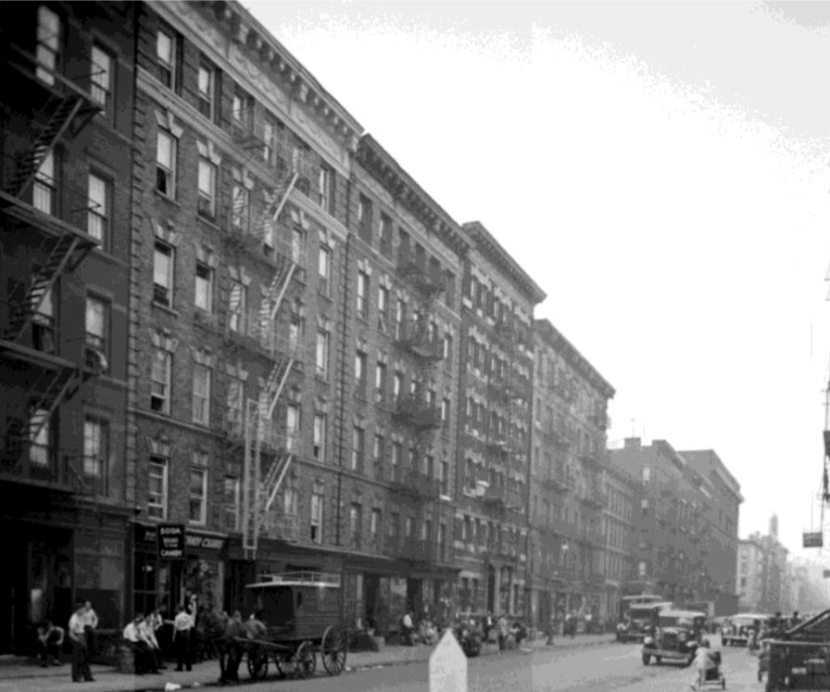
In April 1930 Ben and Martha Frank, and all their children, were renting at 548 E. 183rd St in The Bronx (the rent was $40/month). Ben was a butcher. Robert and Rose Anhaltzer were renting in The Bronx at 615 Pelham Parkway, Apt C12A, with their daughter Lucille. Grace and her Husband Frank Housen were living in The Bronx at 795 E. 168 St. (they had a maid and were paying $75/month rent) but two years later they were living with Robert and Rose at 615 Pelham Parkway. (Rose and Grace were still public-school teachers, Robert and Frank were still butchers). Arthur and Dorothy Anhaltzer were living at 1268 Olmstead Ave, Apt 6 in 1931. Arthur was a salesman. Granddaughter Louraine, daughter of Arthur and Dorothy, was born there in 1931. Grandson Herbert, son of Robert Anhaltzer, was born in 1937. Sometime between 1934 and 1935 Minnie and Robert Horn moved to The Bronx, to 456 E. 186th St.
Joseph’s brother Henry died in Pittsburgh on December 23, 1935. In Europe, war was coming. In March 1936, Germany occupied the Rineland. Leopoldine’s sister Emma was in Europe in mid-1936 and retured July 19, 1936 abord the SS President Harding. Leopoldine’s sister Josefa and her cousin Albert Schwarzfärber and most of his family (including son Ignaz Schwarzfärber, Martha’s future son-in-law) made it out of Austria in mid-1939 and moved to The Bronx along with Emma. The infamous Kristallnacht took place in Austria shortly thereafter, on November 9, 1939. (A daughter of Albert remained in Austria and managed to survive the war.)
In 1940, the country was slowly recovering from long Great Depression. Franklin Roosevelt had been president 7 years, and the country was officially neutral in the European war. Joseph and Pauline were still living in Manhattan at 524 E. 82nd St. Martha and Ben Frank were living at 2280 Bathgate Ave in The Bronx. Ben was a butcher with his own shop. Lillian and William Newborn moved to The Bronx in 1940, living at 2250 Bassford Ave. William was a salesman. Their son Leonard was a butcher living at 2692 3rd Ave in The Bronx. Minnie and Robert Horn were also living in The Bronx by April 1940 at 456 E. 186th St. (Robert Horn had been working as a facilities engineer for Beth Israel Hospital at least since 1933). Grace and Frank Housen were living with their children at 464 E. 159th St. in The Bronx. Grace was teaching at a Jr. Highschool. (She would be teaching high school by 1950.) Frank owned his butcher shop. Robert and Rose Anhaltzer were living at 615 Pellham Parkway in The Bronx (Robert was still a butcher and Rose still a teacher. The occupation of butcher was apparently a family theme.) Arthur and Dorothy Anhaltzer were living at 1180 Lebanon St. in The Bronx. Arthur was a taxi driver.
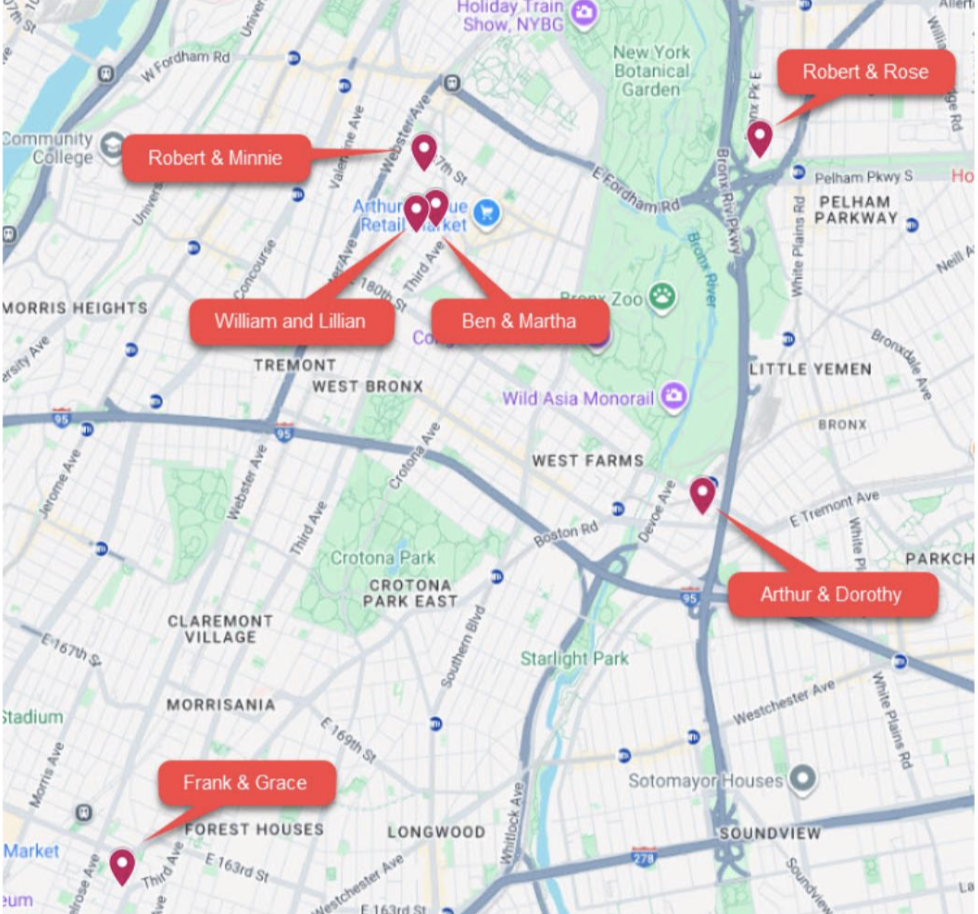

Joseph Anhaltzer died at age 84, on June 21, 1941. He lived long enough to see the rise of Nazi Germany and the start of World War 2. Joseph died at his home at 524 E. 82nd St. His son Robert was the informant on the death certificate. Joseph was buried on June 23 in Mount Lebanon Cemetery, Glendale, Queens, New York. He is buried next to his wife Leopoldine and his daughter Margaret. Ignatz Ferber (aka Ignatz Schwarzfärber ) was listed as the cemetery’s contact person for Joseph’s burial.
All of Joseph’s surviving children had moved to The Bronx by the time of his death except Pauline. Pauline had lived with Joseph from her birth until his death. After Joseph died, Pauline moved in with her sister Lillian and Lillian’s husband William Newborn and was living with them in The Bronx in April 1950.
https://www.familysearch.org/en/tree/person/details/9H7R-ZQ5
https://www.familysearch.org/en/tree/person/details/LYH4-ZSG