 A postcard, an elephant, and a U.S. soldier on the banks of the Saale River – how an incredible coincidence reunited a Jewish family torn apart during the Nazi era. Dieter Marcus tells his story: from Halle to San Diego, California.
By Susann Mertz
Halle, 1945.
The streets are still scarred by the war that has just ended. A bayonet flies through the air. Clack. It lands squarely in a half-broken wooden fence. A boy sits on a street corner, watching the soldiers shyly but with fascination.
“Boy, you wanna try?”
Somewhat bewildered, 13-year-old Dieter Marcus realizes that the U.S. soldier is speaking to him and inviting him to take part. The boy throws the bayonet. But the heavy weapon doesn’t even make it halfway and lands in the dirt. The soldier smiles and prefers to take the knife back himself. A conversation begins.
Dieter Marcus speaks only broken English. He stammers that his father had to flee Germany and now lives in America, in the Bronx, New York. The soldier replies cheerfully in English: “I’m from the Bronx too. Do you know his address?”
The boy does not know it. The only clue Dieter Marcus has to his father’s whereabouts is an old postcard showing the shop where his father works. After that, contact was lost amid the chaos of the war and various relocations.
“Elephant, elephant,” he repeats again and again. That is all he can think of to describe the store’s logo. The soldier looks at him in disbelief: “Elephant? Do you mean the Jumbo Supermarket? We see the elephant every day from our window — we live directly across the street.”
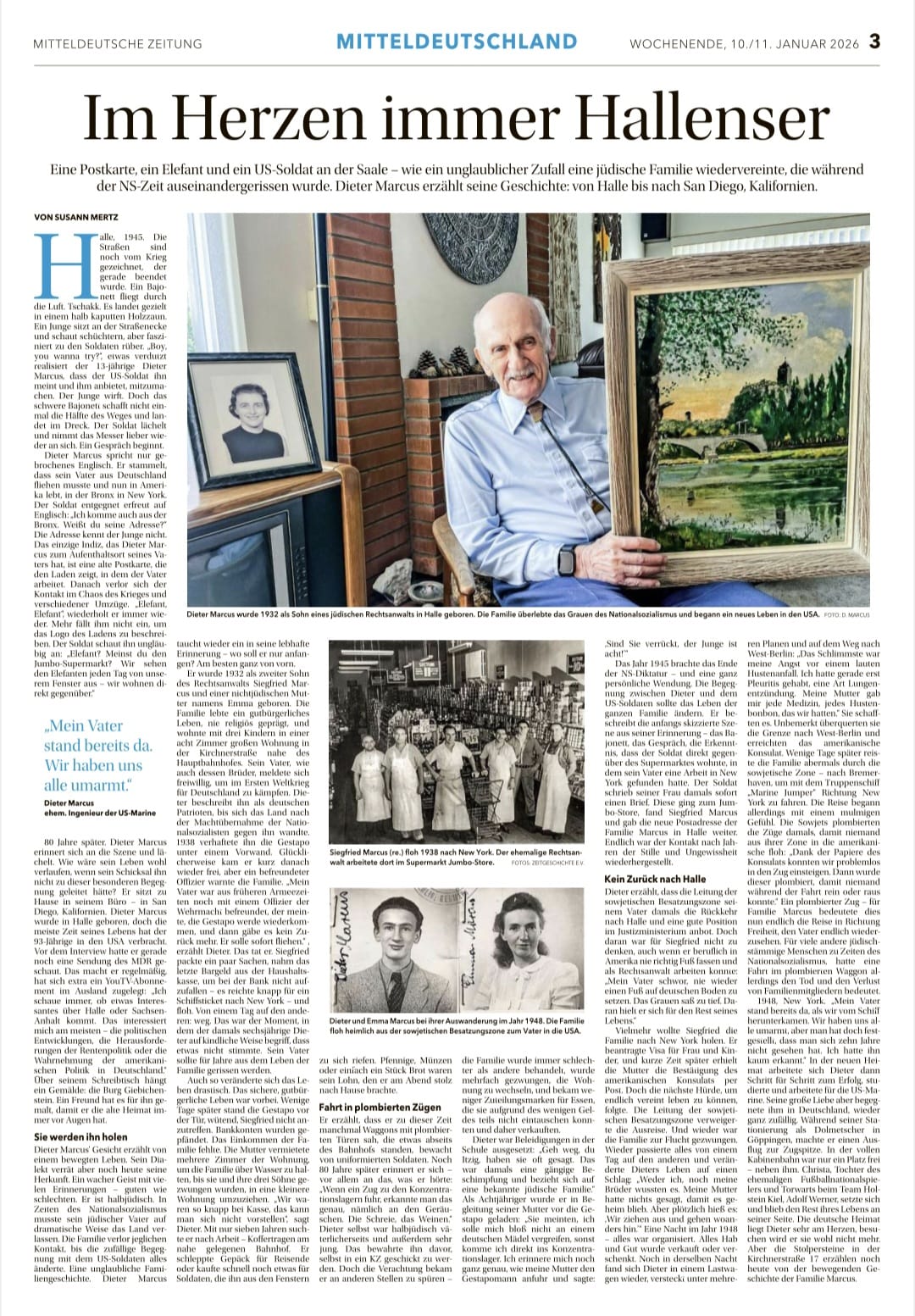
Eighty years later, Dieter Marcus remembers the scene and smiles. How might his life have turned out if fate had not led him to this extraordinary encounter? He is sitting at home in his office — in San Diego, California. Dieter Marcus was born in Halle, but the 93-year-old has spent most of his life in the United States.
Just before the interview, he had been watching a program on MDR television. He does this regularly and even took out a YouTV subscription abroad: “I always check to see whether there’s anything interesting about Halle or Saxony-Anhalt. That interests me most —political developments, the challenges of pension policy, or how American politics are perceived in Germany.”
Above his desk hangs a painting of Giebichenstein Castle. A friend painted it for him so that he would always have his old homeland before his eyes.
They Will Come for Him
Dieter Marcus’s face tells the story of a life full of upheaval. His dialect reveals his origins even today. A sharp mind with many memories — good and bad. He is of Jewish origin on his father’s side. During the Nazi era, his Jewish father was forced to leave the country under dramatic circumstances. The family lost all contact until the chance encounter with the U.S. soldier changed everything. An incredible family story.
Dieter Marcus immerses himself once again in his vivid memories — where should he begin? Best at the very beginning.
He was born in 1932 as the second son of lawyer Siegfried Marcus and a non-Jewish mother named Emma. The family lived a comfortable, middle-class life, was never particularly religious, and the parents lived with three children in an eight-room apartment on Kirchnerstraße near the main railway station. His father, like his brothers, volunteered to fight for Germany in the First World War. Dieter describes him as a German patriot — until the country turned against him after the Nazis came to power.
In 1938, the Gestapo arrested Siegfried on a pretext. Fortunately, he was released shortly afterward, but an officer friend warned the family: “My father was still friends from his army days with a Wehrmacht officer who said the Gestapo would come back, and then there would be no turning back. He told him to flee immediately,” Dieter recounts.
That is what he did. Siegfried packed a few belongings, took the last cash from the household so as not to attract attention at the bank — just enough for a ship’s ticket to New York — and fled. From one day to the next: gone. That was the moment when six-year-old Dieter grasped, in a child’s way, that something was wrong. His father would be torn from the family’s life for years.
Life changed drastically after that. The secure, middle-class existence was over. Just days later, the Gestapo stood at the door, furious that Siegfried was not there. Bank accounts were seized. The family income disappeared. The mother rented out several rooms of the apartment to keep the family afloat until she and her three sons were forced to move into a smaller place.
“We were so short of money, it’s hard to imagine,” Dieter says. At just seven years old, he looked for work — carrying suitcases at the nearby railway station. He hauled luggage for travelers or quickly bought things for soldiers who called him over from windows. Pfennigs, coins, or simply a piece of bread were his wages, which he proudly brought home in the evening.
Journeys in Sealed Train
He recounts that during this time he sometimes saw railcars with sealed doors standing slightly apart from the station, guarded by uniformed soldiers. Even 80 years later, he remembers it — especially what he heard: “When a train went to the concentration camps, you could tell by the sounds. The screaming, the crying.”
Dieter himself was half-Jewish on his father’s side and also very young. That spared him from being sent to a concentration camp himself. But he felt the contempt elsewhere: the family was increasingly treated worse than others, repeatedly forced to move, and received fewer food ration cards, which they sometimes could not redeem due to lack of money and therefore sold.
Dieter was subjected to insults at school: “Go away, you Itzig,” they often said — a common slur at the time referring to a well-known Jewish family.
At the age of eight, he was summoned to the Gestapo accompanied by his mother: “They told me I must not lay a hand on a German girl, otherwise I would go straight to a concentration camp. I still remember exactly how my mother snapped at the Gestapo officer and said: ‘Are you insane? The boy is eight!’”
The year 1945 brought the end of the Nazi dictatorship — and a deeply personal turning point. The encounter between Dieter and the U.S. soldier would change the life of the entire family. He describes the scene outlined at the beginning — the bayonet, the conversation, and the realization that the soldier lived directly across from the supermarket where his father had found work in New York.
The soldier immediately wrote a letter to his wife. She went to the Jumbo store, found Siegfried Marcus, and passed on the new postal address of the Marcus family in Halle. At last, after years of silence and uncertainty, contact was restored.
No Return to Halle
Dieter recounts that the leadership of the Soviet occupation zone offered his father a return to Halle and a good position in the Ministry of Justice. But for Siegfried, that was unthinkable — even though he never truly managed to establish himself professionally in America or work as a lawyer there: “My father swore never to set foot on German soil again. The horror ran too deep. He kept that vow for the rest of his life.”
Instead, Siegfried wanted to bring the family to New York. He applied for visas for his wife and children, and shortly afterward the mother received confirmation from the U.S. consulate by mail. But the next obstacle followed. The authorities of the Soviet occupation zone refused to allow them to leave.
Once again, the family was forced to flee. Once again, everything happened from one day to the next and changed Dieter’s life in an instant: “Neither I nor my brothers knew. My mother hadn’t said anything so it would remain secret. But suddenly it was said: ‘We’re moving out and going somewhere else.’”
One night in 1948 — everything was organized. All possessions were sold or given away. That very night, Dieter found himself in a truck, hidden under several tarpaulins and on the way to West Berlin: “The worst thing was my fear of having a loud coughing fit. I had just had pleurisy, a kind of lung inflammation. My mother gave me every medicine and every cough lozenge we had.”
They made it. Unnoticed, they crossed the border into West Berlin and reached the U.S. consulate. A few days later, the family once again traveled through the Soviet zone — to Bremerhaven, to board the troopship Marine Jumper bound for New York.
The journey began with an uneasy feeling. The Soviets sealed the trains at the time to prevent anyone from fleeing their zone to the American one: “Thanks to the consulate papers, we were able to board the train without any problems. Then it was sealed so no one could get in or out during the journey.”
A sealed train — for the Marcus family, this finally meant a journey toward freedom, toward seeing their father again. For many other people of Jewish origin during the Nazi era, however, a journey in a sealed railcar had meant death and the loss of family members.
1948, New York.
“My father was already there when we got off the ship. We all hugged each other, but you could tell we hadn’t seen each other for ten years. I hardly recognized him.”
In his new homeland, Dieter gradually worked his way toward success, studied, and worked for the U.S. Navy. His great love, however, he encountered in Germany — once again by pure chance. During his posting as an interpreter in Göppingen, he took a trip to the Zugspitze. In the crowded cable car, only one seat was free — next to him. Christa, the daughter of former national football player and Holstein Kiel goalkeeper Adolf Werner, sat down and remained by his side for the rest of his life.
Germany remains very close to Dieter’s heart, though he will probably never visit it again. But the Stolpersteine at Kirchnerstraße 17 still tell the moving story of the Marcus family today.