Thousands of neo-Nazis gathered in the small town of Themar. People like Thomas Jakob fought back with counter-demonstrations and fences. It was worth it – and it changed the town.
By Maria Fiedler, Tagesspiegel
23 October 2019
What do 6,000 neo-Nazis sound like? Thomas Jakob won’t forget it. The 39-year-old sits at the kitchen table of his parents’ house in Themar, Thuringia, and still gets goosebumps thinking about what happened here in 2017. He’s just 300 meters from the meadow where, two years ago, one of the largest right-wing rock concerts in German history took place. “We can understand every word spoken at the concerts over there,” he says. At first, they didn’t know how many right-wing extremists had come. “But when they were all shouting ‘Heil’ and ‘Rudolf Hess,’ we realized: There must be huge numbers of people. It was terrifying.”
After that concert weekend in July 2017, right-wing extremists kept coming back to Themar for right-wing rock events. Bands with names like “Sturmwehr” (Storm Defense) arrived, neo-Nazis wore T-shirts emblazoned with “Even without sun, brown” and “HKNKRZ” (a play on words combining “Krankenwehr,” meaning “Krankenwehr,” and “Krankenwehr,” meaning “Krankenwehr,” meaning “Krankenwehr,” meaning “Krankenwehr,” meaning “Krankenwehr”), and in the festival tent they chanted “Free, social, and national.” The town of Themar, with its 2,800 inhabitants, gained notoriety. It became a symbol of widespread right-wing extremism.
But things have changed. The fact that Themar residents like Thomas Jakob have been actively campaigning against these concerts from the very beginning has paid off. The cooperation between the regional democracy alliance, the authorities, and the police is making things increasingly uncomfortable for the far-right extremists. This year, two concerts flopped – one had a terrible atmosphere, the other was relocated and ended up being much smaller than planned. Thomas Jakob says that for a long time, he and his fellow activists felt their efforts were in vain. “That wears you down eventually. That’s why it’s incredibly important that this year went so well.”
The open-mindedness has been lost.
The story of Themar shows that it can be worthwhile to persevere. But it also tells how this confrontation changes a place. Because Themar is now divided between those who loudly protest against neo-Nazis and those who say: Just let them be, they don’t do anything and they clean up their own mess afterward. Mayor Hubert Böse says that people have lost their natural ease in dealing with each other.
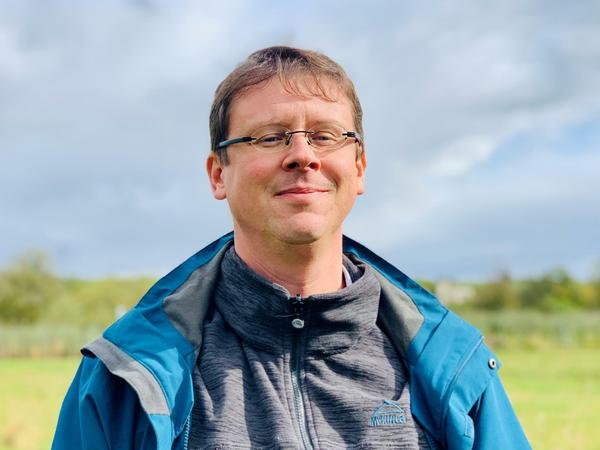
On a dreary autumn day, Thomas Jakob, wearing a blue windbreaker, walks along the main road from his parents’ house to the meadow. Jakob, a social worker and probation officer, was born in Themar. He lives in Erfurt for work but regularly returns with his family on weekends. He is also active in the local SPD (Social Democratic Party). When it became known in 2017 that a far-right rock concert was to take place in Themar, he knew he couldn’t simply stand by and watch. He joined the Alliance for Democracy and Openness, which had been founded in 2015 in response to the rise of far-right activities in southern Thuringia. His mother and sister were also involved.
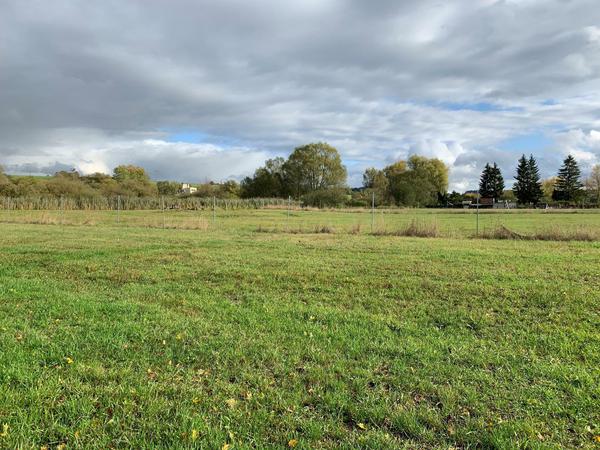
At the edge of town, just past the gas station, Thomas Jakob stops. Here on the meadow, Hitler salutes were given in past summers, and tattooed neo-Nazis sweated it out in the festival tent. Now, only two rows of metal fence posts remain, marking the perimeter of the area. The protest alliance erected them in 2018 to contain the right-wing extremists. “Aryan cage,” some joke in Themar, “Reich field.” Jakob says, “You have to take the whole thing with a grain of salt.”
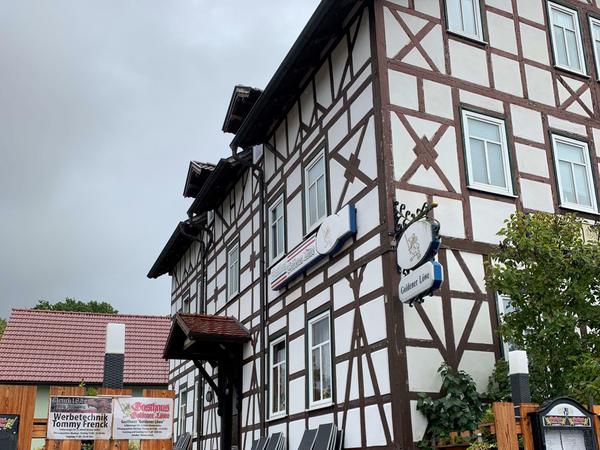
Two kilometers away sits the man without whom all these concerts probably wouldn’t have happened: Tommy Frenck. The 32-year-old chef owns an inn in the neighboring town of Kloster Veßra. The “Golden Lion,” housed in a half-timbered building. Frenck is one of the most active right-wing extremists in the region, having organized right-wing rock concerts for years. In 2017, Frenck registered the event with the 6,000 neo-Nazis; in the following years, he supported the organizers from the NPD (National Democratic Party of Germany). Frenck knows the owner of the festival grounds, local politician Bodo Dressel, well—his car dealership is located across the street from the inn. And if something is ever missing, like a hot water dispenser, Frenck gets one from his storage and drives it over.
Frenck’s ideology is plain for all to see. He was once a German youth champion in weightlifting, and a T-shirt with the slogan “Stop Islamization” stretches across his body. He has the word “Aryan” tattooed on his neck. The inn’s decor also speaks volumes: Behind the bar is a small sign: “I <3 HTLR.” Copies of the magazine “N.S. Heute” (N.S. Today) are on display. Keychains are for sale; one features a moon face with a Hitler mustache.
It’s pointless asking Frenck if he approves of National Socialism. Why he offers schnitzel for €8.88 on Hitler’s birthday. Or why his highly successful online shop is called “Druck18” (Print18). Frenck claims that “Druck18” is no different from “Check24,” that a schnitzel for €7.77 would simply be too cheap, and that the rest is left to the reader’s interpretation. What becomes particularly clear in conversation with the 32-year-old is that he is both a businessman and a networker. Many of the items he sells in his online shop are produced in the region. Every purchase supports his far-right network. And on the side, Frenck is trying his hand at local politics; he sits on the district council with his far-right “Alliance for the Future of Hildburghausen.” He organizes furniture bazaars for the needy, and a pile of toys sits by the door of his local inn—free to take.
“Frenck knows how a village works,” says Thomas Jakob. He doesn’t come across as an aggressive Nazi, but rather presents himself as conservative. In a region where established political parties had eventually withdrawn, Frenck was someone who suddenly offered something. Someone who took charge. “That allowed him to establish himself,” says Jakob.
“We have to protect Themar”
As early as 2015, right-wing extremist activities in the region were being observed in Themar and Kloster Veßra. Shortly before, Frenck had acquired the “Golden Lion” (a local landmark), and right-wing rock concerts were taking place in various locations in southern Thuringia, including Kloster Veßra. Then, in 2017, it became known that concerts were also planned for Themar – registered as political assemblies. “Themar was a place that had never dealt with demonstrations before. It was a very sheltered place,” Jakob explains. “We were clearly overwhelmed by the question of how to defend ourselves. So we started seeking help.”
The alliance turned to Katharina König-Preuss, a member of the Thuringian state parliament from the Left Party, who has been dealing with the far-right scene for years and served on the NSU investigative committee. The residents of Themar also sought help from the “Mobile Counseling Thuringia,” which supports people who are active in the fight against right-wing extremism. As the day of the big concert in July 2017 approached, Thomas Jakob had another idea. He wanted to prevent right-wing extremists from coming to the town itself, parking there, wandering around, and buying alcohol in the shops. His motivation: “We have to protect Themar.”
He suggested registering a demonstration at every access road to the town, so that no one could get through. “That worked,” says Jakob. But it also had side effects: “The downside was that some residents didn’t notice the right-wing extremists. They said, ‘They’re not doing anything.'” The only thing many people noticed was the counter-protest throughout the town. And that was viewed with suspicion.
As the right-wing rock festival approached in the summer of 2018, the district office tried to stop the event – arguing that the loud music would disturb rare bird species. But that argument didn’t hold up in court, and even an alcohol ban was relaxed – light beer and shandy could be served in the evening. And nothing stopped the right-wing extremists from getting drunk beforehand at the nearby gas station.
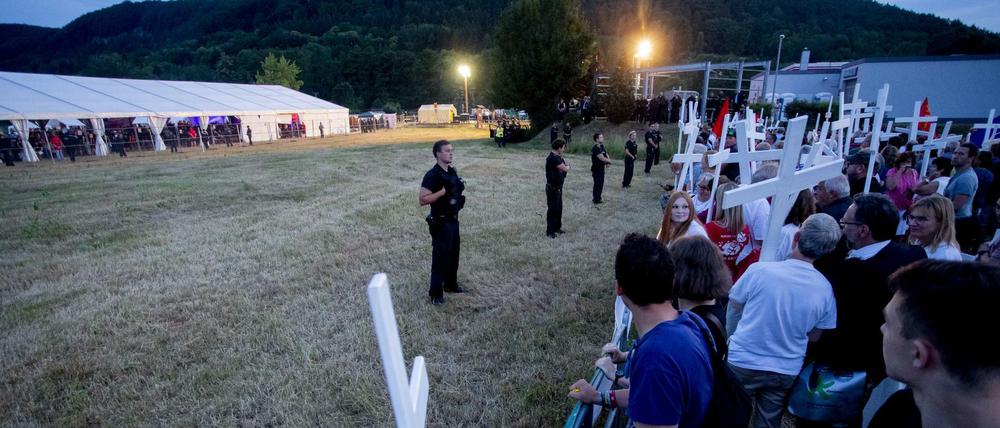
On the evening of the first day, residents of Themar gathered in the Protestant church. The Thuringian Minister of the Interior was also present. They are commemorating the people who have fallen victim to right-wing extremist violence since 1990. For each of them, there is a white cross, 193 in total. The residents of Themar carry them to the festival grounds at dusk.
The next day: a democracy festival in the city center. Despite everything, a total of 2,000 right-wing extremists will have celebrated in the city that July weekend.
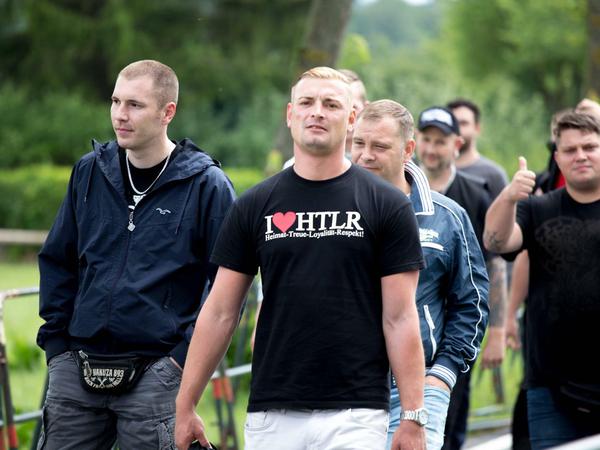
The turning point came in 2019. In Thuringia, a task force was established to support municipalities dealing with far-right rock concerts. The alliance led by Thomas Jakob registered demonstrations on both sides of the festival grounds. The action was controversial among the participants: Did they really want to get so close to the far-right extremists, to be subjected to far-right rock music all day? Thomas Jakob believed there was no other way. “By daring to get so close to the Nazis, we’ve made it less attractive to them.”
Two bands were removed from the stage.
The local authorities and police worked together. The alcohol ban remained in place; no alcohol at all was allowed on the second day, and only light beer on the first evening. The police rented the gas station and used it as an operations center.
Observers reported a tense atmosphere among the festivalgoers: Some had gotten “drunk” at Tommy Frenck’s inn in Kloster Veßra, but sobered up during the two-kilometer walk to Themar. They would have had to walk past the demonstrators, some of whom were singing “There’s no beer in Hawaii.” State security, along with experts on right-wing extremist music, was present in the town. Two bands were removed from the stage.
The next rally was scheduled for September, but due to illness among two bands and an entry ban, only a scaled-down event was planned at Frenck’s Inn. This attracted significantly fewer participants than anticipated, resulting in more counter-protesters than right-wing extremists for the first time. For the anti-right-wing alliance in Themar and Kloster Veßra, it was a major success.
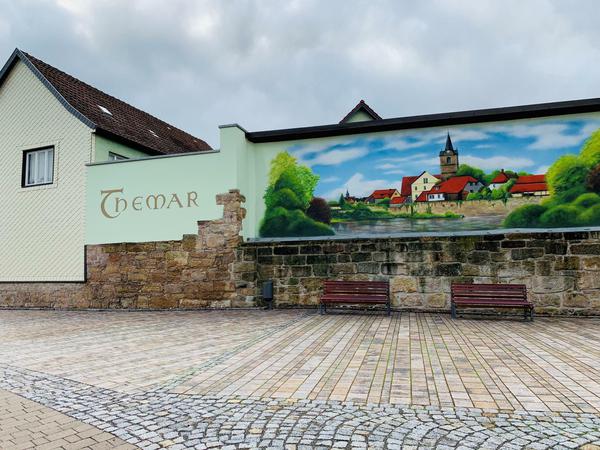
Visiting Mayor Hubert Böse at the town hall in the old town, one doesn’t find him particularly euphoric. Böse – gray sweater, neat crew cut – has been mayor of Themar for almost 20 years. He was involved in the counter-protests from the very beginning and is pleased that the resistance has recently been successful. However, he has a bad feeling about the state elections. “I expect the AfD to perform just as strongly as they did in Saxony,” he says. It would be a bitter setback for the protest in Themar if the AfD were to win a direct mandate here in the region. They have the support of people like Frenck, who says that his views and those of Björn Höcke overlap by 98 percent.
What many don’t know: Themar has a tragic Jewish past. The residents of Themar only learned about it in 2008 through the research of Canadian historian Sharon Meen. Before the Nazis seized power, 75 Jews lived in the town; some moved away, the rest were deported. “No one was left,” says Böse. “When we learned that, it was a very formative experience for us.” The residents of Themar laid dozens of Stolpersteine (stumbling stones) in the town, and events were held annually, including gatherings with descendants of the Jewish citizens. When neo-Nazis came to the town in 2017, Böse apologized to the descendants. “I also felt I owed it to these people to take a stand against these concerts.”

Thomas Jakob and his fellow activists now intend to take legal action. They want to have it determined that the right-wing rock concerts are not political assemblies, but rather entertainment events. If so, different rules would apply; for example, the concert organizers would have to provide their own security, which costs money.
On Saturday evening, however, there was a brief respite: The left-wing punk band “Feine Sahne Fischfilet” gave a solidarity concert at the shooting range in Themar. The aim was to celebrate the people who are active “where others have long since moved away,” explained singer Jan Gorkow. Meanwhile, 70 supporters of Tommy Frenck stood outside the shooting range. They couldn’t accomplish much.