This page summaries the story of Rosa and Jacob (also spelled occasionally “Jakob”) Edelmuth as we know it as of January 2026. A page created earlier tells the story of how we learned about Rosa and Jacob starting in 2009, but it is much more about the process of research. See “Discovering the Story of Rosa and Jakob Edelmuth.”
*****
Rosa Wertheimer, b. 1887 in Themar, was the middle child of Nathan and Malwine (née Frankenberg) Wertheimer. Both her parents were born the same year, 1859, and in the same village: Marisfeld. Rosa had two siblings: older brother Julius, b. 1886, and younger sister Bella, b. 1890. The three children were all born in the town of Themar in Thüringen (or Sachsen-Meiningen as it was then).
Jacob Edelmuth was born in the town of Beuern in Hesse on
14 January 1884. How and when he and Rosa met is not known. They married on 20 August 1912 in Halle an der Saale. Their daughter, Lieselotte, was born in 1913 in Halle an der Saale. A son, Siegbert, was born in 1917. A wartime record in the Arolsen Archives tells us that Jacob Edelmuth served in the German army during World War I, one of the 12,000 Jewish men who fought for their homeland between 1914 and 1918.
*****
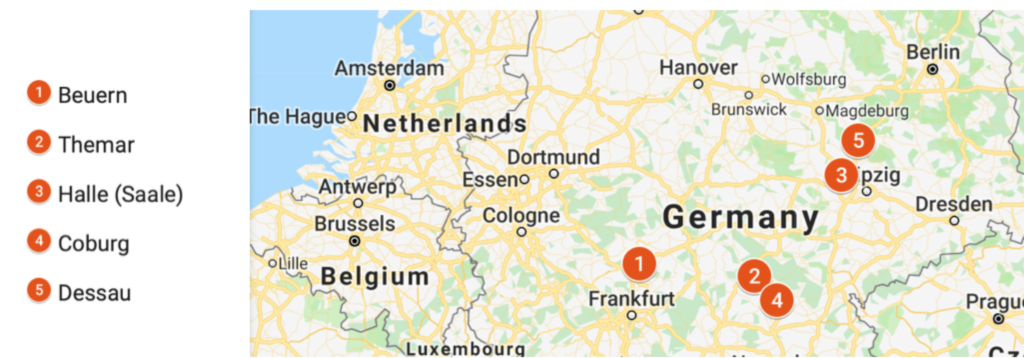 As the map above indicates, movement within Germany was a key pattern of the the Edelmuths’ lives; desire and need for economic opportunity, and family ties, were probably the motivating factors. Initially Rosa and Jacob may have lived in Halle an der Saale because Jacob worked for Nathan Frankenberg, Rosa’s uncle (brother of Malwine Wertheimer, née Frankenberg). Nathan and his wife, Minna (née Gassenheimer), ran the Halle branch of the Gassenheimer agricultural works.
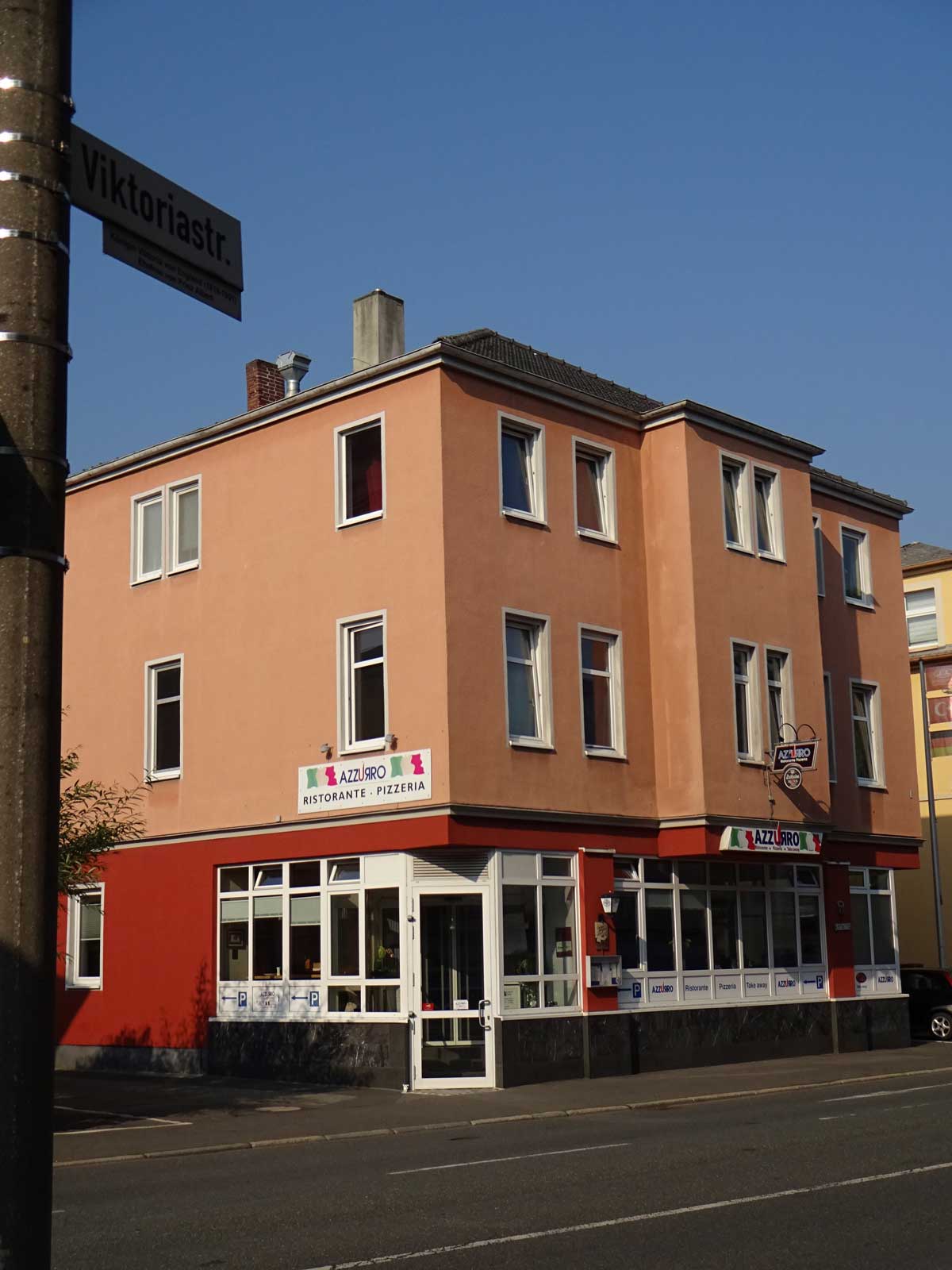
What happened to prompt a move from Halle to Coburg is not known. Perhaps it was the growing family cluster of Wertheimers in Coburg that pulled them rather than something in Halle pushing them. Regardless, in spring 1919 the four Edelmuths moved to Coburg. They lived at Viktoriastraße 1, a building owned by Rosa’s father. In 1921, Rosa’s sister, Bella, with her husband, Milton, also lived in this house. In his entries in the address books of Coburg, Jacob identified himself as a “Kaufmann” or business man.
*****
The Edelmuth family was in Coburg when the Nazi Regime began. We believe that the 1933 photo below of a Jewish Scout group in Coburg includes Siegbert Edelmuth. (The person who has the photo identifies the person as simply “Edelmuth.”)

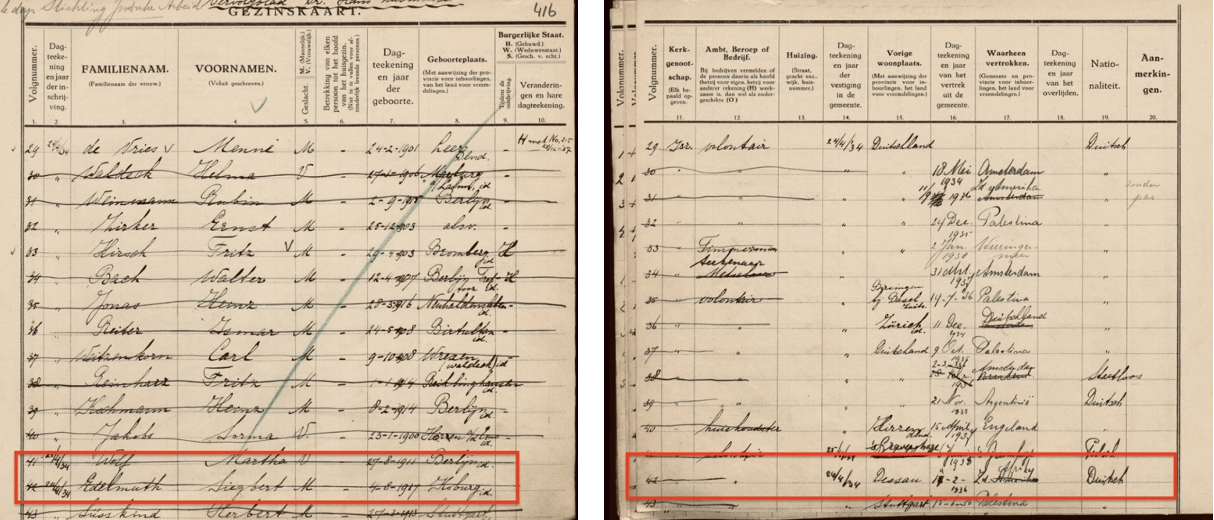
But the Edelmuths left Coburg in 1933, although possibly for reasons other than the political changes. In early July 1933, 20-year-old Lieselotte left Germany and went to the Netherlands. On 1 November 1933, she married Erwin Georg Sigfried Karl Meder, a non-Jew, who had moved from Germany to the Netherlands in 1926. Rosa, Jacob, and Siegbert also left Coburg in 1933, choosing to go to Dessau in Saxony.

In 1934, Siegbert Edelmuth left Dessau and Germany; details of his birth, etc. are entered in the Netherlands Population Register in April 1934. In February 1936, he left the Netherlands, and Europe, and immigrated into South Africa.
*****
From 1933-early 1939, Rosa and Jakob (sic) lived at Franzstrasse 3-4/II. Jakob continued to identify himself as a Kaufmann in the Dessau Address Book.

In mid-October 1934, Nathan Wertheimer, Rosa’s father, left Coburg and came to Dessau to live at Franzstrasse.
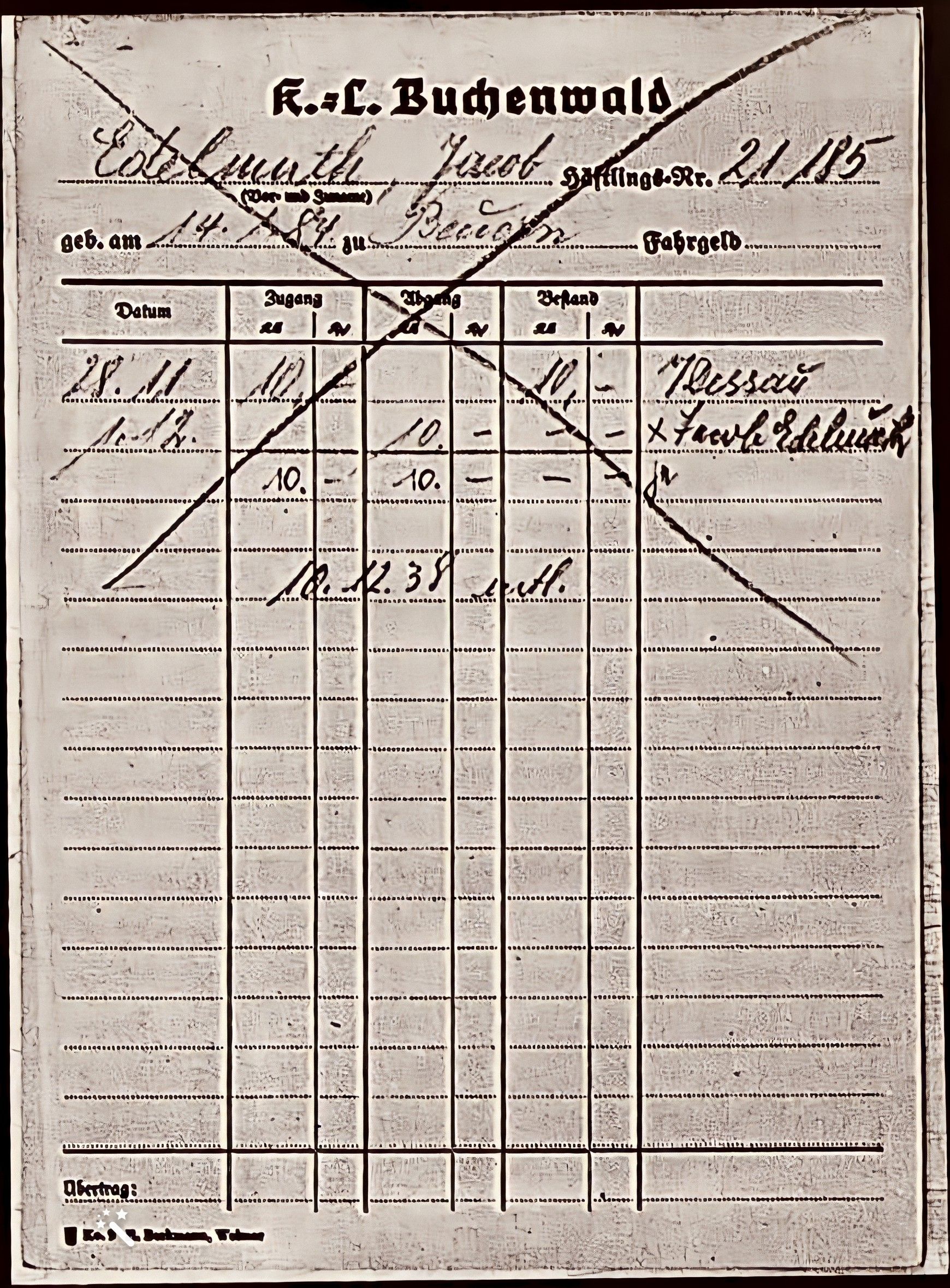
On 9/10 Novem-ber 1938, Jacob was taken into so-called ‘protective custody’ (Schutz-haft) and taken to Buchen-wald KZ. He was not released until 10 Decem-ber 1938.
We do not know if Rosa and Jakob had started to explore the possibility of emigration before November 1938, but with Jacob’s arrest and imprisonment, they made concrete plans. Their decision was to join their daughter Lieselotte in the Netherlands: on 13 January 1939, Jacob Edelmuth arrived in the Netherlands; a month later, Rosa and her father joined him. They lived at Slaakstraat 11 III in Rotterdam. Milton Wertheimer, husband of Rosa’s sister Bella, was also in the Netherlands but in Amsterdam where he had been since his arrival in 1936.
Unfortunately, emigration to the Netherlands did not provide safety. The invasion of the Netherlands in May 1940 more or less trapped the Edelmuths even though the first years of Nazi occupation were somewhat bearable. On 15 July 1942, however, the deportations from the transit camp of Westerbork began. Eighty-three-year-old Nathan Wertheimer, Rosa’s father, died on 3 August 1942 and thus evaded deportation. But, on 3 October 1942, Rosa and Jacob Edelmuth were rounded up in Rotterdam and taken to the transit camp of Westerbork where they remained imprisoned for more than six months.
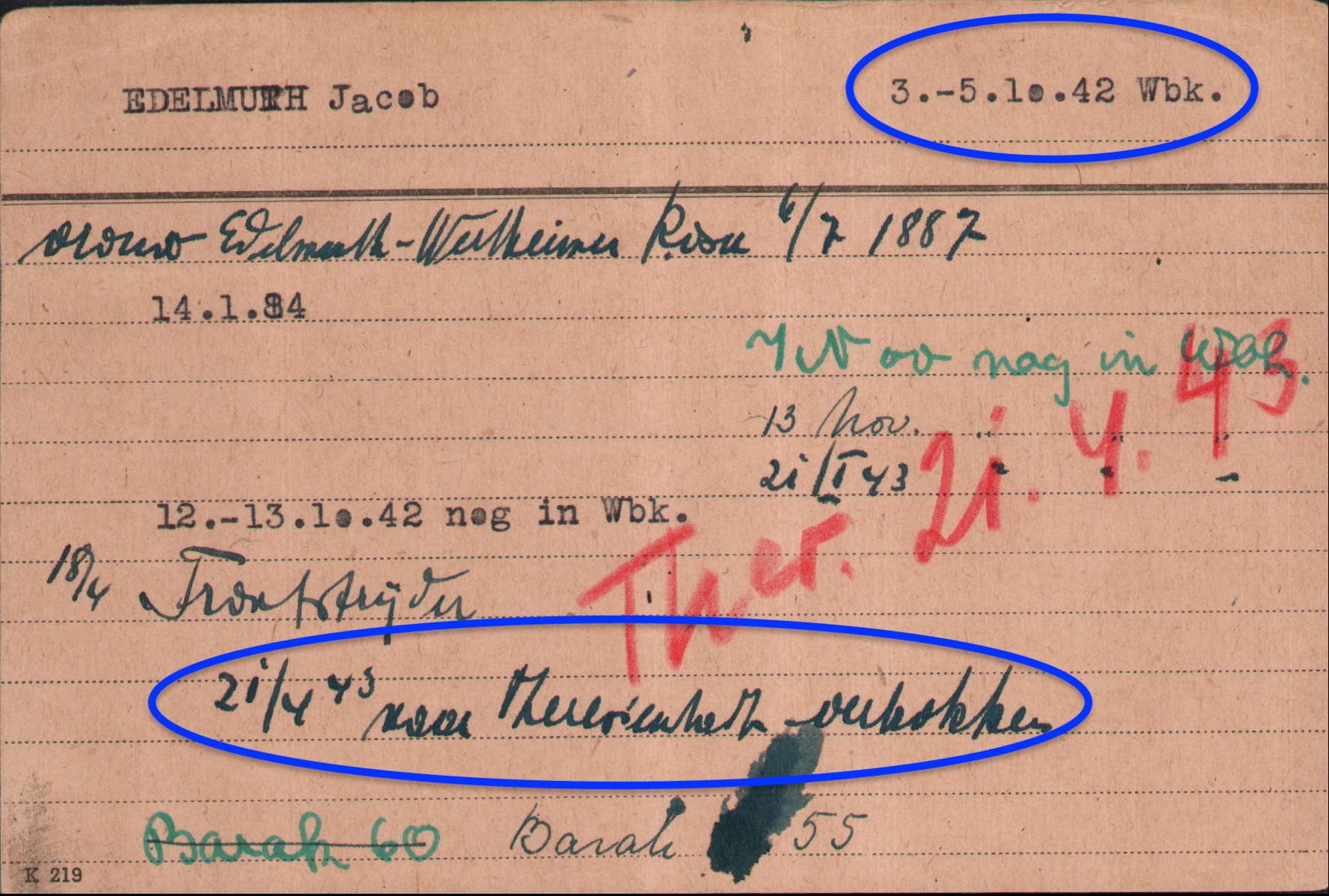
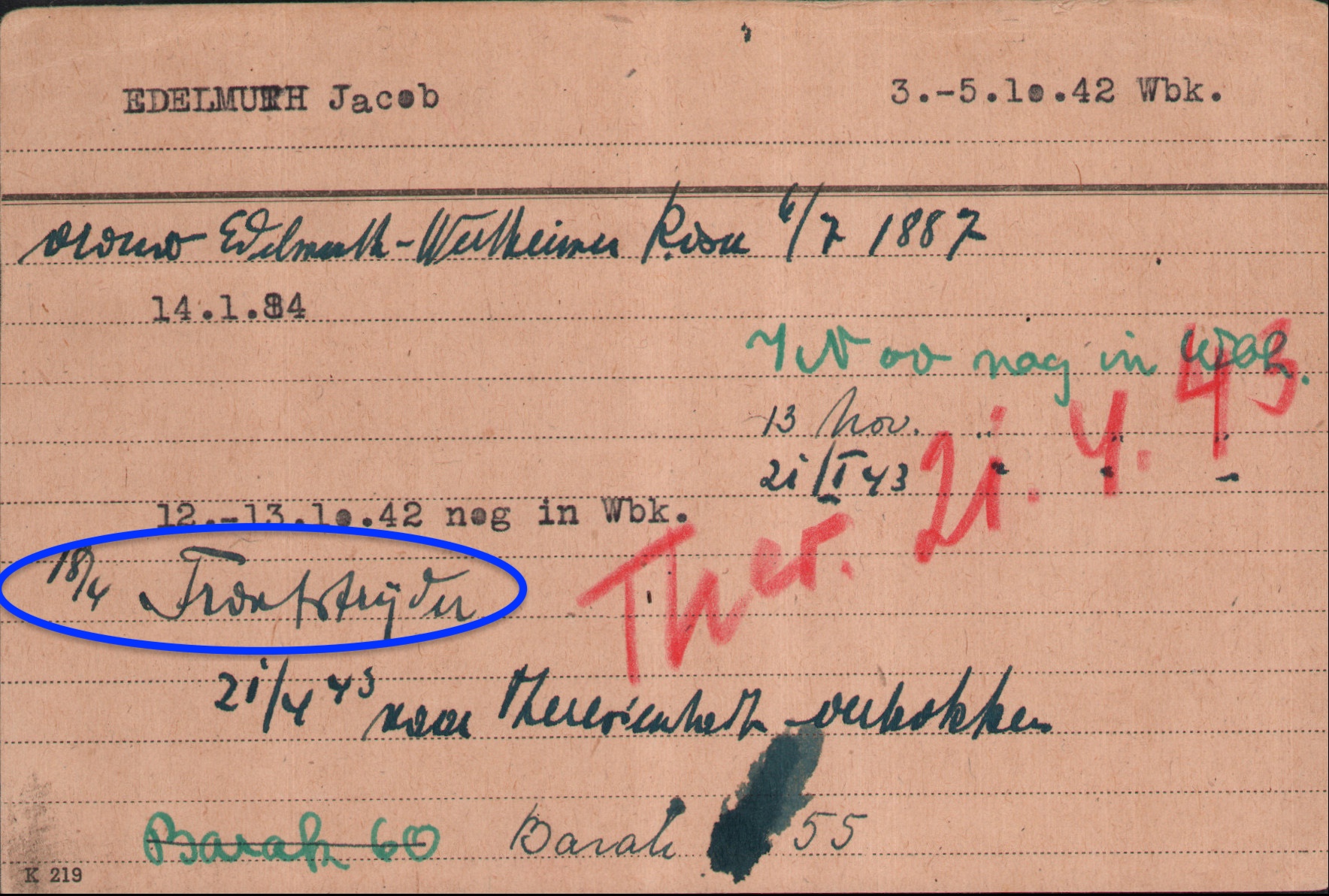
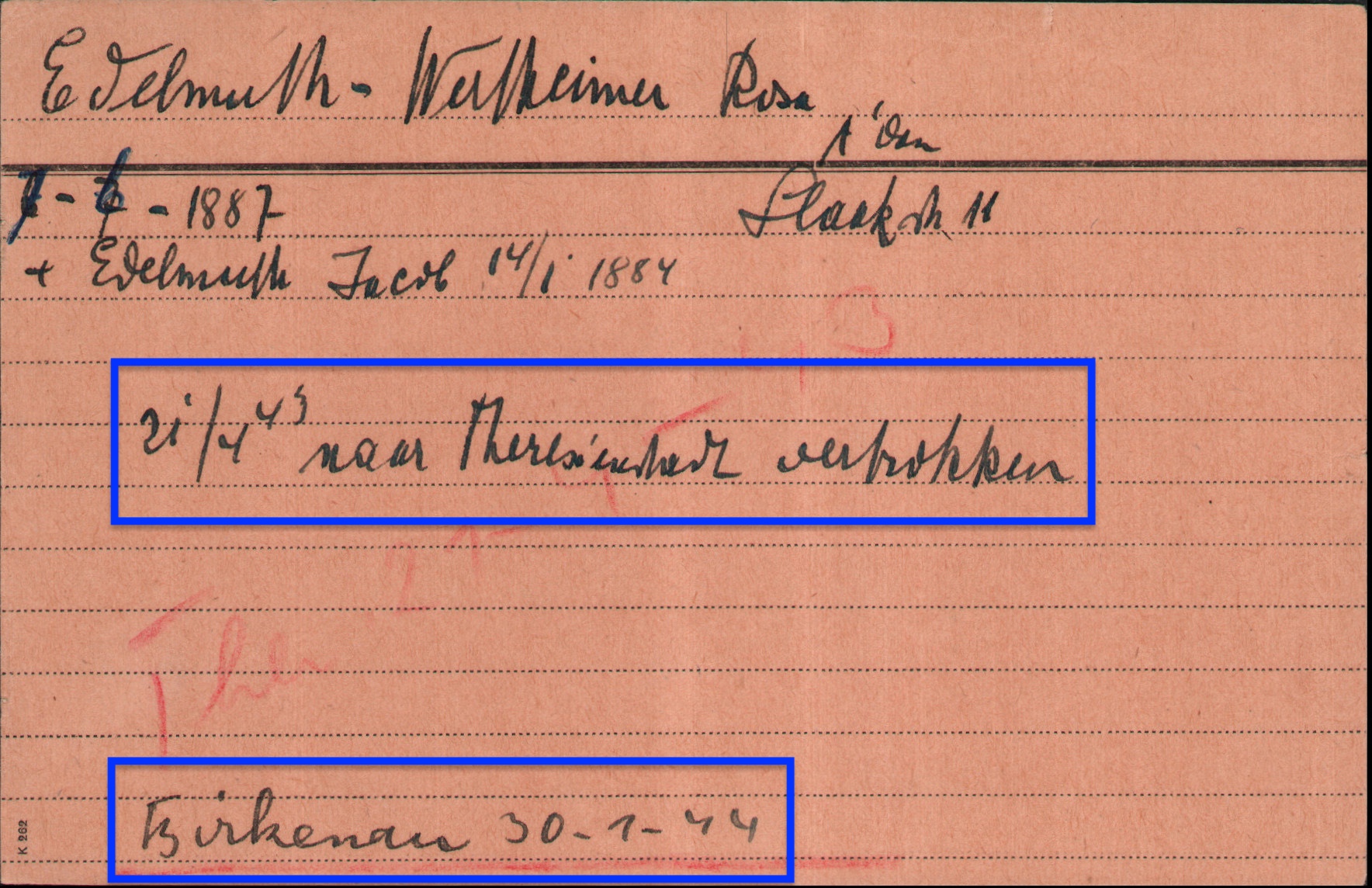
On 21 April 1943, Rosa and Jacob Edelmuth were on the first transport from Amsterdam to Theresienstadt Ghetto. According to the deportation chronology on the Gedenkbuch site, this transport of 295 people “consisted exclusively of German Jews, of whom 195 were taken from Westerbork.” Among them were World War I soldiers who had been decorated or wounded who were told that the ghetto in Theresienstadt was a retirement home for privileged Jews. Whether Jacob Edelmuth was one of these soldiers we do not yet know although the notation “Frontline soldier” on the index card may indicate that he was. Milton Wertheimer, husband of Rosa’s sister Bella, was on the same transport. Whether he and Rosa knew that Bella had been deported from Thüringen on 10 May 1942 to Belzyce Ghetto, is unknown.
Rosa and Jacob were in the Theresienstadt Ghetto six months before being transported further to Auschwitz-Birkenau. Both were murdered in Birkenau on 9 March 1943.
*****
Their children survived the war and Holocaust. Lieselotte had the protection of being married to a non-Jew. After the war, she and her husband emigrated from Holland to South Africa where Siegbert lived. Siegbert Edelmuth died on 03 September 1981 and was buried in the West Park Cemetery, Johannesburg, South Africa.1Weltweites jüdisches Bestattungsregister von JewishGenErwin Meder died in South Africa about 1983. After their deaths, Lieselotte returned to Germany and died there about three years later.
On 20 March 2015, Stolpersteine were laid for Rosa Edelmuth, née Wertheimer, and Jacob Edelmuth in front of the house they lived in in Dessau. 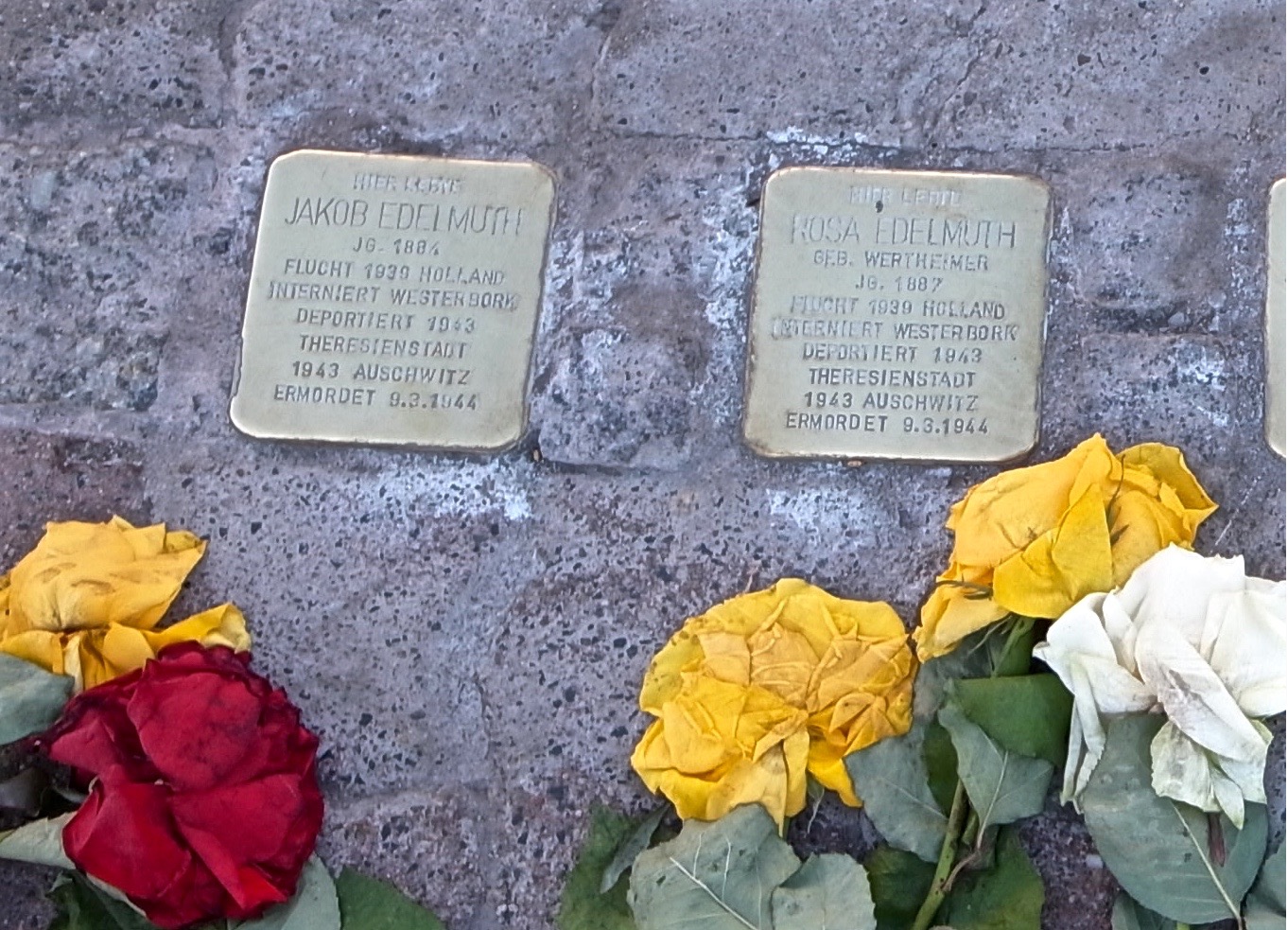
We wish to acknowledge the contributions of Lisa van Beek, Bernd Ulbrich, and Gabriela Schuller, which made the telling of this story possible. Thank you!
If you wish to comment, please contact s.meen79@gmail.com